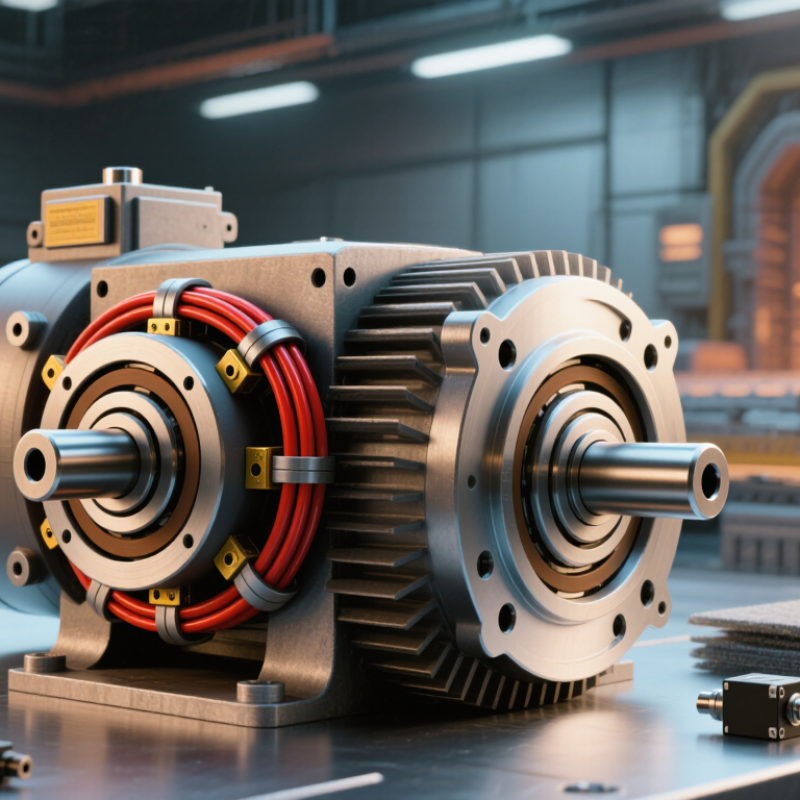
Global buyers are entering 2026 with stricter demands for motion systems used near furnaces, reactors, sterilization chambers, and high-speed production lines. An Ultra High Temperature Servo Motor must deliver accurate positioning while surviving sustained heat, vibration, dust, and repeated thermal cycling. The challenge is not simply finding a motor with a high temperature rating. It is matching insulation, magnets, bearings, seals, encoder systems, cooling methods, and drive compatibility.
The International Energy Agency reports that motor-driven systems consume roughly half of global electricity. Its energy-efficiency research highlights the importance of efficient, correctly controlled motors in industrial operations. MarketsandMarkets and Grand View Research also identify continued growth in servo motors, driven by robotics, semiconductor equipment, packaging, and advanced manufacturing. However, most market reports combine standard and high-temperature servo products. Their figures should not be treated as precise evidence for this specialist segment. That limitation matters.
Professor Ion Boldea, a widely cited electrical-machines researcher, offers a practical engineering reminder: “Thermal performance determines practical motor performance.” Buyers should therefore examine measured torque curves, allowable ambient temperatures, insulation life, encoder limits, and maintenance requirements. Ask for test conditions. Ask for failure data.
A motor may survive a brief heat spike. That proves little.
This 2026 guide compares leading solutions for international purchasers. It considers verified specifications, application experience, supplier transparency, and total operating risk. The strongest choice may not have the highest peak temperature. It may provide the most dependable accuracy after months of heat exposure. Some conclusions remain application-dependent, and that uncertainty deserves honest attention.
Ultra high temperature servo motors are built for conditions where standard motors lose accuracy, insulation life, or both. Their windings use heat-resistant insulation, while magnets and bearings must tolerate continuous thermal stress. The rated temperature matters, but so does the rating method.
A motor rated for 180°C may refer to winding temperature, not surrounding air. That difference can change a safe installation into an early failure. Reliable selection requires checking ambient temperature, duty cycle, peak torque, and thermal cycling. In a furnace line, for example, repeated movement from room temperature to 150°C can damage seals and connectors before the motor itself fails.
These motors often include reinforced feedback systems, high-temperature cables, and sealed bearing structures. Cooling may depend on airflow, a heat shield, or controlled mounting. Do not assume a higher temperature number means better performance. Oversizing can increase inertia, while poor cable routing can create hot spots near the encoder. A practical review should include insulation class, permissible speed, overload duration, ingress protection, and service access.
Some specifications remain unclear across suppliers. That is a problem. Global buyers should request test conditions, derating curves, thermal-cycle data, and measured torque at operating temperature. Laboratory results are useful, but field conditions are messier. Dust, vibration, and uneven cooling may expose weaknesses that a clean test never shows.
When selecting a high-temperature servo motor, verify its rated ambient temperature. Do not rely only on maximum winding temperature. A motor rated for 180°C internally may require a much cooler housing surface. Check continuous torque at the actual operating temperature. Peak torque figures can mislead during eight-hour production cycles. I prefer thermal curves showing torque reduction at 120°C, 150°C, and 180°C. Small details matter.
The insulation system should state its thermal class and expected life under repeated heating. Ask for magnet retention data, bearing lubricant limits, and encoder temperature ratings. The encoder often fails first. Resolver feedback may tolerate heat better, but it can increase commissioning effort. Confirm feedback resolution, electrical interface, and cable flexibility after heat exposure. A rigid cable becomes a maintenance problem.
Review ingress protection, shaft sealing, mounting tolerances, and allowable vibration. Test the complete motor, cable, brake, and feedback device together. In one commissioning review, the motor passed bench testing but overheated beside a furnace. Airflow had been ignored. That was our mistake. Request temperature-rise methods, sample reports, and traceable calibration records. Supplier claims need evidence. Compare warranty conditions at elevated temperatures, because standard limits may not match your process. Leave thermal margin; real factories are rarely as stable as laboratory chambers.
2026 Best Ultra High Temperature Servo Motors for Global Buyers
Top Ultra High Temperature Servo Motor Types for 2026
Ultra high temperature servo motors support demanding equipment near furnaces, dryers, and sealed processing chambers. Their insulation systems, bearings, seals, and feedback devices must tolerate sustained heat. The correct type depends on ambient temperature, duty cycle, torque, and available cooling space.
High-temperature permanent magnet servo motors suit compact machinery requiring precise position control. Air-cooled models are simpler to install, but airflow can weaken inside crowded enclosures. Water-cooled servo motors remove heat more efficiently during continuous operation. They need clean coolant, reliable seals, and regular leak inspections. Frameless motors work well in robotic joints and custom spindle assemblies. Their integration is flexible, but engineering effort increases.
Tips: Confirm the motor’s continuous temperature rating, not only its peak rating. Check encoder limits separately. Measure housing temperature during a realistic load test. Leave thermal margin for blocked vents, dust, and seasonal changes. No selection is perfect. I would not trust a catalogue number without application data. Some systems also require remote feedback electronics because sensors may fail near extreme heat. Review cable insulation, lubricant performance, mounting materials, and maintenance access before ordering. A small thermal survey can prevent expensive redesigns.
Top ultra-high-temperature servo motor types are compared by the maximum temperature associated with their insulation thermal class. These values follow internationally recognized thermal-class designations and are not guaranteed ambient operating temperatures.
How to read the chart: Class F and Class H designs are widely used for high-temperature servo applications, while Class 200 and Class 220 systems are intended for more specialized environments. Actual continuous performance depends on cooling, load, duty cycle, bearings, seals, installation altitude, and the manufacturer’s derating curve.
2026 Best Ultra High Temperature Servo Motors for Global Buyers
Selecting an ultra high temperature servo motor starts with the machine, not the catalog. Define the ambient temperature near the motor, including heat from ovens, molds, or radiant surfaces. Then calculate continuous torque, peak torque, speed, acceleration, and duty cycle. A motor rated for high temperature may still fail when frequent starts create additional heat. Feedback accuracy also matters. Precision positioning needs a suitable encoder and stable signal performance under thermal stress. Check the motor, cable, connector, and drive as one system.
Tips: Record the hottest operating point during a real production cycle. Leave thermal margin instead of using the maximum rating. Match the enclosure to dust, oil, moisture, and cleaning methods. Confirm cable flexibility at low and high temperatures. Ask for test data, not only marketing claims. Regional voltage, documentation, and service availability can affect global installation.
Application details often expose hidden problems. A slow indexing table may need high holding torque, while a fast packaging axis needs low inertia and rapid response. In a furnace line, shielding and remote mounting may reduce heat exposure. In my experience, engineers sometimes size motors from average load values. That choice can be wrong. Short overloads and poor ventilation change the result. Prototype testing under actual temperature, load, and motion patterns remains valuable, even when the specifications look convincing. Recheck assumptions. Temperature is rarely constant.
For global buyers, ultra high temperature servo motors demand more than a wide temperature label. The U.S. Department of Energy reports that motor-driven equipment uses over 70% of industrial electricity. Efficiency losses become expensive when machines operate continuously. Ask suppliers for measured torque, insulation life, thermal rise, and speed stability at your actual duty cycle.
Quality evidence should be traceable. Require production test records, serial-level calibration, bearing specifications, and thermal chamber results. IEC 60034 standards provide useful references for rotating-machine performance and temperature testing. However, IEC compliance alone does not prove suitability for every furnace, vacuum line, or high-temperature enclosure. That is an easy assumption to make.
Compliance also depends on the destination market. Check electrical safety, electromagnetic compatibility, environmental restrictions, and documentation language before ordering. Supplier support matters just as much. Confirm spare-part availability, remote troubleshooting, repair timelines, and commissioning assistance. The IEA has estimated that electric motor systems consume roughly 45% of global electricity, showing why small efficiency differences deserve attention. Request a factory acceptance test with your load profile. In practice, buyers sometimes accept generic curves too quickly. That can create costly surprises after installation. A reliable supplier should explain derating, cable limits, encoder behavior, and cooling requirements clearly. Fancy specifications are not enough.
| Buying Dimension | Evaluation Metric | Recommended Benchmark for Ultra-High-Temperature Servo Applications | Why It Matters to Global Buyers | Documents or Evidence to Request | Priority |
|---|---|---|---|---|---|
| Thermal Capability | Continuous ambient operating temperature | Confirm the complete motor-and-feedback-system rating. Common engineering ranges are approximately 0°C to +100°C, while specialized designs may target +125°C to +180°C with application-specific derating. | Motor temperature limits are often lower than the surrounding process temperature. Incorrect interpretation can cause insulation, bearing, encoder, or cable failure. | Validated temperature derating curve, thermal test report, operating manual, and defined installation conditions. | Critical |
| Insulation System | Thermal class and winding-temperature margin | Insulation Class H is rated for a 180°C maximum hot-spot reference under applicable standards. The selected motor should also provide a documented temperature rise and safety margin. | Insulation class alone does not prove that the entire motor is suitable for continuous ultra-high-temperature operation. | Insulation-system specification, winding-temperature test results, and thermal endurance documentation. | Critical |
| Thermal Protection | Winding temperature sensing | Prefer embedded PTC, PT100, PT1000, or equivalent temperature sensing, with the sensor type and resistance curve clearly identified. | Real-time protection helps prevent thermal damage during overload, low-speed operation, blocked airflow, or high process temperatures. | Wiring diagram, sensor accuracy range, trip-temperature settings, and drive compatibility statement. | Critical |
| Torque Performance | Continuous and peak torque at rated temperature | Evaluate continuous torque, peak torque duration, speed range, and torque derating at the actual ambient temperature. Do not compare only the room-temperature nameplate value. | High temperature reduces available thermal margin and may reduce continuous torque, acceleration, and duty-cycle capability. | Torque-speed curves at the target temperature, duty-cycle calculation, and overload-time limits. | Critical |
| Speed Capability | Rated speed and maximum operating speed | Request separate rated and maximum speeds, together with permissible overspeed, rotor balance grade, and temperature-specific speed limits. | Bearings, seals, feedback devices, and rotor dynamics may impose limits that differ from the electromagnetic motor rating. | Speed-torque map, overspeed-test record, balancing information, and mechanical-limit statement. | High |
| Bearing System | Bearing temperature and lubrication method | Verify bearing type, lubricant temperature range, relubrication interval, and whether the motor uses high-temperature grease or a special bearing arrangement. | Lubricant degradation and clearance changes are frequent causes of failure in elevated-temperature applications. | Bearing specification, lubricant technical data sheet, service interval, and bearing-life calculation at operating temperature. | Critical |
| Feedback System | Encoder or resolver temperature rating | Ensure that the feedback device, connector, and cable are rated for the same temperature zone as the motor. Specialized resolvers may be preferred where encoder electronics cannot tolerate high heat. | The feedback device can become the limiting component even when the motor windings remain within their thermal rating. | Feedback datasheet, resolution or pole-pair information, temperature rating, accuracy data, and drive-interface compatibility. | Critical |
| Ingress Protection | Protection rating and environmental sealing | Select the required IP rating according to IEC 60529. IP65 provides dust protection and protection against water jets; higher ratings may be required for washdown or immersion risks. | Actual protection depends on shaft seals, connectors, cable glands, mounting orientation, and correct installation—not only the motor enclosure. | IP test report, sealing arrangement drawing, connector rating, and installation instructions. | High |
| Electrical Compliance | Motor design and test standards | Request conformity with relevant IEC 60034 requirements, including rating and performance requirements under IEC 60034-1 where applicable. | Recognized standards improve technical comparability and reduce uncertainty during international approval and commissioning. | Declaration of conformity, routine-test report, type-test report where applicable, and applicable standard list. | Critical |
| Drive Compatibility | Servo-drive, feedback, and cable matching | Confirm rated voltage, current, back-EMF constant, torque constant, feedback protocol, brake requirements, cable capacitance, and permissible switching frequency. | A motor and servo drive must be treated as a matched system. Incorrect combinations can create overvoltage, overheating, instability, or encoder faults. | Motor-drive compatibility matrix, electrical parameter sheet, pinout, cable specification, and commissioning parameters. | Critical |
| EMC Performance | Electromagnetic compatibility | Assess the complete drive system against the relevant IEC 61800-3 environment and installation category, including shielding, grounding, and cable length. | EMC performance depends on the motor, drive, cable, cabinet, grounding, and installation layout as a complete system. | EMC test results, cable-shielding instructions, grounding diagram, and recommended maximum cable length. | High |
| Mechanical Interface | Mounting, shaft, flange, and load connection | Verify frame size, flange dimensions, shaft diameter, keyway, allowable radial and axial loads, mounting orientation, and inertia compatibility. | Mechanical mismatch can cause vibration, coupling damage, premature bearing wear, and inaccurate servo response. | Dimension drawing, tolerance table, allowable-load data, inertia value, and coupling recommendations. | High |
| Reliability Quality | Production testing and traceability | Require routine testing of winding resistance, insulation resistance, dielectric strength, no-load current, vibration, encoder operation, and temperature-sensor continuity as applicable. | Traceable test records provide stronger quality assurance than catalog specifications alone. | Serial-number traceability, routine-test certificate, calibration records, nonconformance process, and sample inspection plan. | Critical |
| Safety Compliance | Functional-safety suitability | Where required, evaluate STO, safe brake control, or other safety functions at the drive-system level in accordance with the applicable safety architecture and IEC 61800-5-2 requirements. | A motor alone normally does not establish the safety integrity of the complete machine. | Safety manual, safety certificate where applicable, failure-mode data, and system-level validation guidance. | Application-specific |
| Global Regulatory Readiness | Export documentation and market access | Confirm the required declaration, labeling, customs classification, country-of-origin information, electrical documentation, and local approval requirements before shipment. | Regulatory gaps can delay customs clearance, installation approval, or customer acceptance. | Declaration of conformity, commercial invoice data, packing list, technical file index, and region-specific compliance documents. | High |
| Supplier Support | Application engineering capability | Prefer suppliers able to review thermal maps, duty cycles, load inertia, process temperature, mounting conditions, feedback selection, and drive parameters before order confirmation. | Ultra-high-temperature applications often require engineering validation rather than direct catalog substitution. | Completed application questionnaire, calculation report, technical drawing approval, and named engineering contact. | Critical |
| Supplier Support | Spare parts and serviceability | Check availability of feedback devices, cables, connectors, bearings, seals, brakes, and repair instructions for the expected service life. | Replacement of a small high-temperature component may otherwise require a complete motor change. | Spare-parts list, recommended stock levels, repair procedure, lead times, and service-center coverage. | High |
| Commercial Risk | Warranty and failure analysis | Obtain written warranty conditions covering temperature, duty cycle, installation, feedback devices, cables, and approved drive combinations. | Clear boundaries reduce disputes when failures involve system integration or operation outside the specified envelope. | Warranty terms, exclusions, return-material process, root-cause-analysis procedure, and corrective-action commitment. | High |
| Lifecycle Cost | Total cost of ownership | Compare purchase price together with derating, cooling requirements, cable replacement, maintenance, spare inventory, energy use, downtime risk, and expected service life. | The lowest initial price may create higher costs if the motor requires frequent replacement or special cooling. | Five-year or application-life cost model, energy estimate, maintenance schedule, and expected replacement lead time. | High |
| Final Selection Rule | Acceptance decision | Approve only after the motor, feedback, cable, drive, thermal protection, enclosure, and installation conditions are validated as one complete system. | Ultra-high-temperature performance is a system property; a single high-temperature component does not guarantee reliable operation. | Signed technical specification, application validation report, approved drawings, and pre-shipment inspection checklist. | Mandatory |
We are here to help you with all your queries and concerns, just write to us using the below form and we will get back to you as soon as we can.