Choosing the right 4 wheel drive forklift for sale is not simply a matter of comparing prices. The machine must match your ground conditions, lifting tasks, working hours, and maintenance capacity. A forklift that performs well on a warehouse floor may struggle badly on loose gravel, wet concrete, or uneven loading yards.
Materials-handling consultant David Goss explains, “Four-wheel drive improves access, but it does not replace correct capacity planning, operator training, or site assessment.” That point deserves attention. Buyers should check rated capacity, lift height, turning radius, tire type, ground clearance, and attachment compatibility. A 5,000-pound capacity may sound sufficient, yet the real limit changes when the load is raised or extended. Small details matter.
Inspect the mast for leaks, listen for unusual transmission noise, and examine tire wear across both axles. Request service records, not only sales promises. For used equipment, test cold starting, braking, steering, hydraulics, and four-wheel drive engagement. New forklifts also require careful comparison because specifications can hide costly differences.
Budgeting only for the purchase is an easy mistake. Fuel use, tires, batteries, repairs, insurance, and operator training affect the total ownership cost. I would not ignore resale value either. Sometimes the cheapest option becomes the most expensive machine on the site. This guide will examine practical buying criteria, common warning signs, and questions to ask before choosing a 4 wheel drive forklift for sale. One overlooked measurement can change everything.
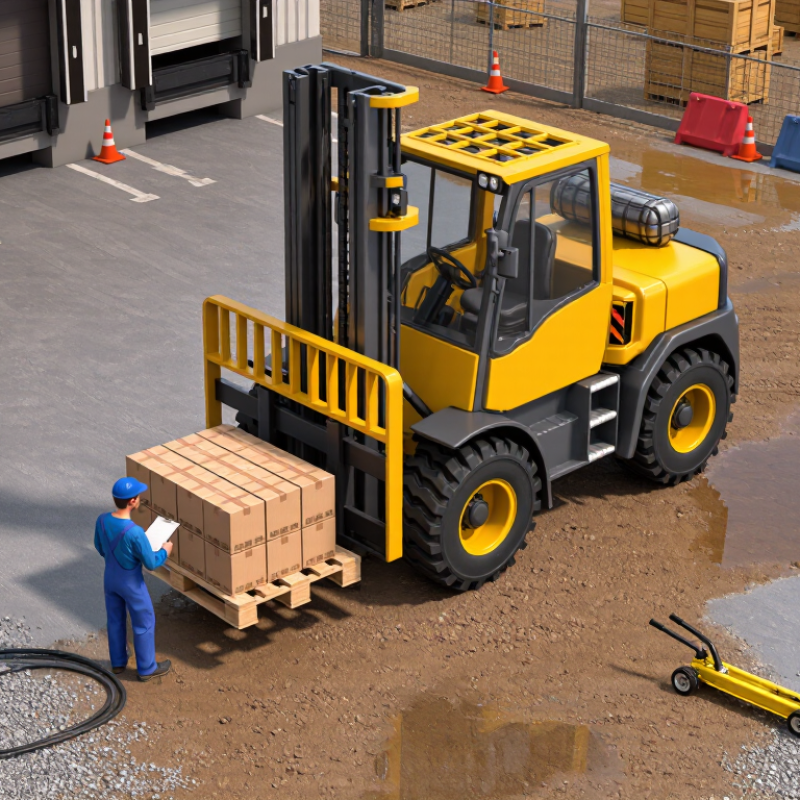
A suitable 4 wheel drive forklift starts with the actual load, not the advertised capacity. Record the heaviest pallet, its dimensions, and the attachment used. A 5,000-pound rating may decrease when the load sits far from the carriage. Check the capacity chart at your required lift height. Ask for the data plate and service records. Guessing here can create an expensive and unsafe mismatch.
Lift height also affects stability and daily efficiency. Measure the highest rack beam, doorway, and storage platform. Leave clearance for uneven floors and changing loads. Then examine the terrain. Mud, gravel, wet grass, and broken concrete demand strong ground clearance, suitable tires, and predictable traction. Four-wheel drive helps, but it cannot replace careful speed control. Test the forklift on the surface where it will actually work.
Duty cycle reveals whether the machine can handle the schedule. Occasional loading may need less cooling capacity than continuous yard work. Count operating hours, travel distance, idle time, and shifts per day. Inspect steering response, brakes, mast movement, tires, leaks, and warning systems. A practical trial with a real load is more useful than polished photographs. I would also question my first estimate, because seasonal mud or heavier pallets can change the whole purchase decision. Assume conditions will be slightly worse than planned.
A reliable four-wheel-drive forklift should match your actual lifting conditions, not just its advertised capacity. Check the data plate carefully. It should state the rated capacity at a specific load center, often 24 inches. This measurement matters. A 2,000-kilogram rating at 24 inches may drop sharply when the load extends farther forward. Measure your pallets, crates, and attachments before comparing machines. I once saw a forklift pass a basic yard test but struggle with a long steel bundle. The load center was the overlooked detail.
Ask the seller for capacity charts, service records, and the original operating manual. Confirm whether the rating applies to the installed mast height and attachment. A side-shift carriage, fork extension, or clamp can reduce usable capacity. Tire condition also affects stability on rough ground. Inspect the four-wheel-drive system, steering joints, brakes, mast rollers, and hydraulic leaks. Test the forklift with a representative load, on the same surface used at your site. Do not rely only on a clean appearance. That is an easy mistake.
Tips: Mark the 24-inch load center on a sample pallet. Then compare its weight and dimensions with the forklift plate. Keep the heaviest load low during testing. Ask a qualified technician to review uncertain figures. If the numbers seem confusing, pause before buying. The cheapest option may become expensive after one incorrect capacity assumption.
A 4WD forklift is not automatically the best choice for every outdoor job. Match its capability to your site’s grades, ground clearance, and tire type. On a sloped yard, gradeability matters more than a powerful engine alone. Check the rated climbing angle with the intended load, not an empty truck. A fully loaded forklift may slow sharply on loose gravel.
Measure the ground before comparing machines. Ruts, drainage channels, and broken pavement can expose a low chassis to impact. Higher ground clearance helps the forklift cross uneven areas, but it can also raise the center of gravity. Keep loads low and travel slowly. Stability still matters.
Tire selection changes daily performance. Pneumatic tires provide useful cushioning and traction on gravel, soil, and rough concrete. Solid pneumatic tires resist punctures, but they may transmit more vibration to the operator. Cushion tires usually suit smooth indoor floors better. That distinction is easy to miss.
During a site inspection, mark the steepest route and measure its surface condition. Then ask the seller for lift capacity, clearance, turning radius, and gradeability data. Request a loaded demonstration if possible. Numbers can look convincing. Real ground often disagrees.
I would avoid choosing 4WD only for occasional mud. It adds cost, maintenance, and turning resistance. Still, I once underestimated how quickly rain softened a storage yard. That mistake changed the decision. The right forklift must fit the worst regular conditions, not the easiest day.
How to Find the Best 4 Wheel Drive Forklift for Sale?
A four-wheel-drive forklift must handle more than loose gravel and muddy yards. It should also meet ANSI/ITSDF B56.6 requirements for rough-terrain forklift safety. This standard addresses stability, controls, operator protection, visibility, and safe operating instructions. Ask the seller which B56.6 edition applies and request written compliance evidence. A sales claim alone is not enough.
OSHA estimates that powered industrial trucks cause about 85 workplace fatalities and 34,900 serious injuries annually in the United States. These figures show why capacity plates and safety systems matter. Check the rated load at the actual load center, not only the maximum advertised capacity. Test the brakes, steering, mast chains, tires, seat belt, lights, and overhead guard. On uneven ground, a small defect can become a serious problem. I would also inspect hydraulic leaks after the machine works under load. A clean exterior can hide expensive wear.
Tips: Confirm the operator manual is present. Match tire type to your terrain. Request maintenance records and a recent inspection report. Test stability on a controlled slope, with qualified supervision. Do not ignore awkward visibility. B56.6 compliance does not replace operator training, site rules, or daily checks. OSHA data is useful, but it cannot predict every jobsite risk. Mistakes still happen. That is why a practical inspection should challenge the seller’s promises.
Before choosing a four-wheel-drive forklift for sale, match capacity with attachments, load center, slopes, and ground clearance. Start with total cost of ownership, including purchase price, energy, tires, service, downtime, training, and resale value. OSHA reports approximately 85 forklift-related deaths and 34,900 serious injuries annually in the United States. This makes maintenance a production concern, not merely a workshop expense. Request service intervals, parts availability, labor rates, and typical repair times in writing. A cheap quote can age badly.
Compare warranty length, exclusions, response time, and mobile repair coverage. Ask who pays for travel, batteries, axles, drivetrain components, and accidental damage. Review the terms with your maintenance supervisor. Promises are not coverage. MHI’s 2024 Annual Industry Report found that 55% of respondents expected supply-chain investment to increase. That pressure can favor durable equipment, but it may also encourage rushed purchases. Use logged operating hours and terrain data instead of optimistic estimates. Measure fuel or battery consumption under actual loads. Maybe the larger machine is unnecessary.
OSHA 29 CFR 1910.178(l)(4) requires an operator performance evaluation at least every three years. Include this cycle in the ownership plan, not after an incident. The evaluation is not automatic retraining. Retraining may follow unsafe operation, an accident, a different truck, or changed workplace conditions. Keep signed records.
During demonstrations, inspect cold starts, steering response, braking, tire wear, and hydraulic drift. A practical trial often reveals more than a polished quotation. My weak point is assuming every warranty is equally useful; the exclusions usually tell the real story.
We are here to help you with all your queries and concerns, just write to us using the below form and we will get back to you as soon as we can.