

-

97 Auto Road, County of Vermilion River, AB T0B 0L0
-

-

97 Auto Road, County of Vermilion River, AB T0B 0L0

China’s steel industry operates at a remarkable scale. The World Steel Association reported 1,019.1 million tonnes of crude steel production in China in 2023, in World Steel in Figures 2024. That figure shows industrial scale, not cart demand. Still, it helps explain why safe, controlled coil movement matters across busy production sites.
A Coil Transfer Cart must match the real load, route, and working environment. Coil weight and width are only part of the assessment. Engineers should also verify coil diameter, loading method, floor condition, turning space, and travel frequency. A cart that looks suitable on a specification sheet may not suit a narrow aisle or uneven floor. Details matter.
When evaluating the Best Coil Transfer Cart Manufacturer in China, buyers should request clear load ratings, dimensional drawings, control details, and maintenance guidance. Ask how the design handles coil restraint, stopping, and operator visibility. Battery-powered, rail-guided, and cable-powered models serve different layouts; none is automatically the best choice. No shortcut.
A reliable supplier should explain trade-offs and provide evidence for its claims, rather than promise a universal solution. Site-specific review is essential. Even experienced teams can overlook turning clearance or future load changes, so checking these details early is worthwhile. The right manufacturer helps make coil handling safer and more predictable, while acknowledging that equipment performance depends on proper installation, operation, and upkeep.
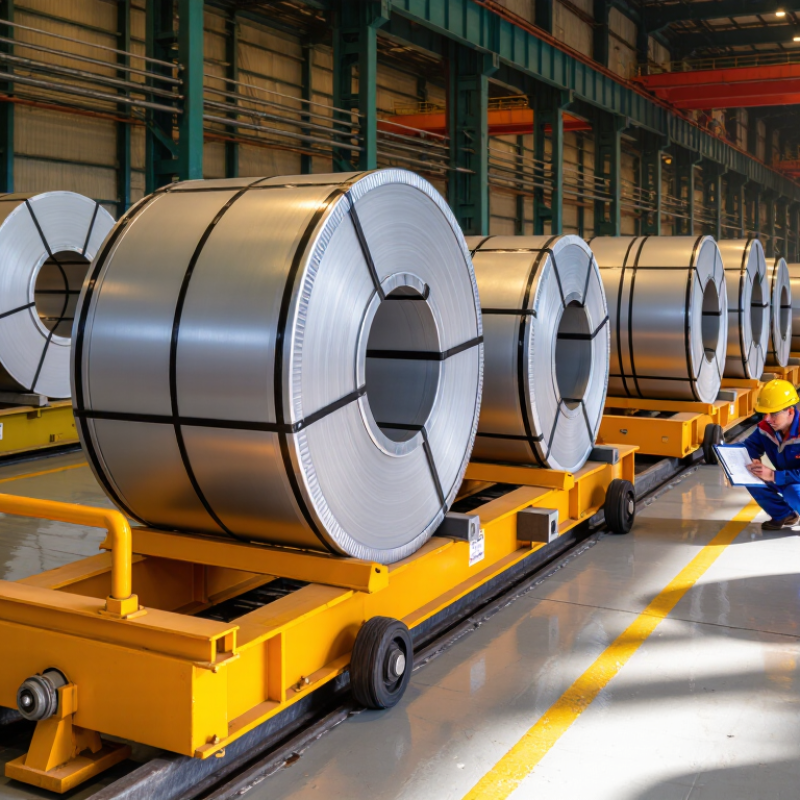
Best Coil Transfer Cart Manufacturer in China
What a Coil Transfer Cart Is and How It Moves Coils
A coil transfer cart is a powered platform built to move heavy steel coils between work areas. Its deck often carries a shaped cradle that keeps the coil from rolling. Some carts run on rails; others travel on industrial floors. The right design depends on coil weight, route, turning space, and loading method. The scale is significant: World Steel Association’s World Steel in Figures 2024 reports 1,892.2 million tonnes of crude steel production in 2023. That figure describes the industry, not cart demand, but it shows why safe coil movement matters.
During operation, an operator positions the cart beneath a crane or coil-handling station. The load is lowered into the cradle, then secured according to the cart’s design. A motor drives the wheels, while brakes and controls manage stopping and direction. On a rail system, the route is predictable, but floor condition and alignment still matter. A small mismatch can become a recurring problem. Capacity, braking performance, and emergency-stop access should be checked against the actual route and load.
Tips: Confirm coil dimensions and the heaviest expected load before selecting a cart. Keep the cradle clean, inspect wheels and brakes, and test the route without a load. Do not assume a smooth floor means a safe journey; joints, debris, and tight turns can change how the cart behaves.
A coil transfer cart is a powered industrial vehicle designed to move steel, aluminum, or other heavy coils between work areas. The figures below are typical design considerations, not universal specifications; actual capacity and performance depend on the coil, route, floor, and operating conditions.
| Dimension | Typical Information | Why It Matters |
|---|---|---|
| Primary purpose | Transporting coils between storage areas, production lines, inspection stations, and loading points. | Reduces repeated crane handling and supports a more organized material flow. |
| Load capacity | Selected to match the maximum coil weight plus any tooling or fixtures carried on the cart. Industrial designs range from a few tonnes to well over 100 tonnes. | The rated capacity must safely cover the heaviest planned load, including the support structure. |
| Coil support | Common options include V-shaped saddles, cradles, or purpose-built supports sized for the coil diameter and width. | Correct support helps prevent rolling, shifting, and damage to the coil or cart. |
| Travel path | May be designed for a fixed route, a guided path, or travel across a suitable plant floor. | Route layout affects steering, turning space, floor requirements, and traffic control. |
| Movement and drive | Electric drive motors turn the wheels or wheel assemblies. The cart may use rail guidance or a steering system for floor-running travel. | Drive and guidance choices should suit the route, load, operating cycle, and available infrastructure. |
| Power supply | Depending on the design, power may come from onboard batteries, a cable or reel system, or a conductor-based supply. | Power selection influences travel range, charging or cable management, and maintenance planning. |
| Travel speed | Often configured for controlled, low-speed movement in industrial areas; the safe operating speed depends on the load and site conditions. | Speed limits should account for stopping distance, visibility, pedestrians, and the stability of the coil. |
| Loading and unloading | Coils are commonly placed on or removed from the cart using an overhead crane or another suitably rated lifting system. | Clear coordination between the lifting equipment and cart operator helps reduce handling risks. |
| Safety features | Depending on the application, features may include emergency stops, audible or visual warnings, limit switches, bumpers, and remote or pendant controls. | Safety devices should be selected through a site-specific risk assessment and maintained regularly. |
| Floor and route conditions | Floor-running carts require a route and floor capable of supporting wheel loads; rail-guided systems require correctly installed and maintained track. | Floor strength, level changes, joints, drainage, and clearances affect safe travel and equipment life. |
| Key selection checks | Confirm coil weight and dimensions, route length, turning requirements, operating frequency, power availability, floor or rail conditions, and control method. | These details provide the basis for choosing a suitable cart configuration and verifying its operating limits. |