Top 10 Alloy Wheel Curing Oven Manufacturers Worldwide

Selecting a reliable Alloy Wheel Curing Oven manufacturer involves more than comparing brochure temperatures. Wheel geometry, coating chemistry, line speed, and loading patterns all shape the curing result. A glossy finish can hide uneven heat distribution. The problem may appear only after production begins.

A useful quality perspective comes from W. Edwards Deming, the quality-management expert. He is widely associated with the reminder, “In God we trust; all others must bring data.” For oven buyers, that means asking for evidence: temperature-uniformity records, airflow details, control-system specifications, and references from comparable installations. Deming was not an alloy-wheel oven specialist, so his principle is applied here as a quality lens, not as a sector-specific endorsement.

This guide introduces ten manufacturers serving the worldwide market. It considers oven design, process control, customization, service support, and experience with wheel-coating applications. Look closely at practical details: how burners or electric elements are arranged, whether airflow reaches the inner barrel, and how operators monitor part temperature. Small differences matter.

There is no universal best supplier. A compact batch oven may suit one workshop, while a continuous system fits a high-volume line. The ranking should be treated as a starting point, not a purchasing verdict. Verify current specifications directly with each manufacturer. Ask for a production trial when possible. A site visit can reveal what a catalog cannot.
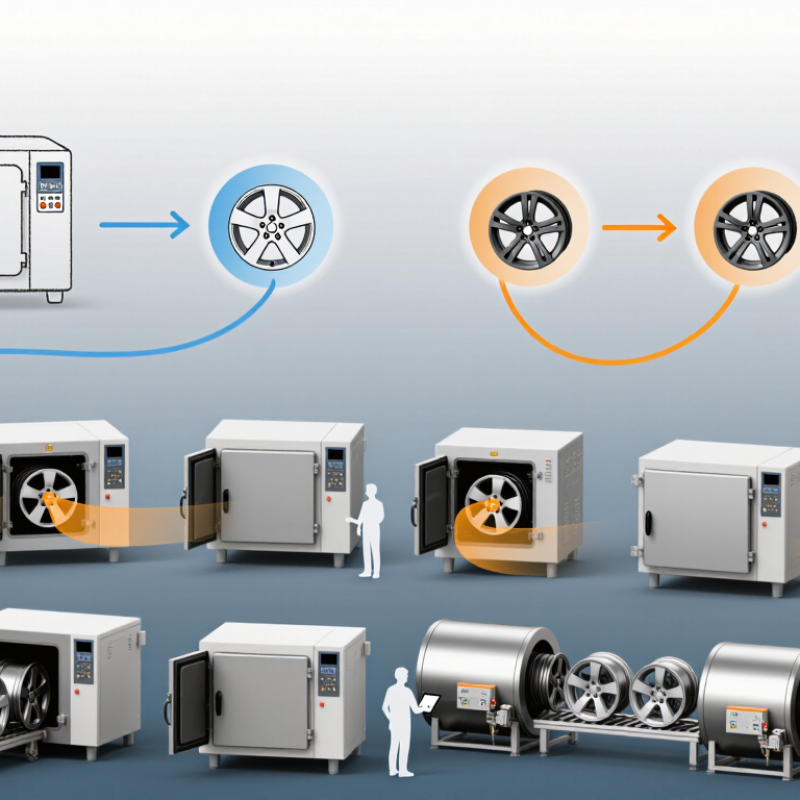
Top 10 Alloy Wheel Curing Oven Manufacturers Worldwide

What Is an Alloy Wheel Curing Oven?

An alloy wheel curing oven is a controlled thermal chamber that hardens the coating applied to a wheel. In powder coating, heat melts and cross-links the powder into a continuous protective film.

It is not simply a large dryer.

Convection systems circulate heated air around suspended wheels, while sensors and controls help maintain a stable cycle. Some lines use infrared heating or combine it with convection.

Details matter. Air temperature alone does not prove the wheel itself has reached its required cure temperature. A probe placed on a thick hub or spoke can reveal that gap.

Many powder-coating schedules fall roughly between 160°C and 200°C at the metal surface, but the coating supplier’s technical data sheet should set the actual time and temperature. Wheel mass, geometry, and oven loading affect heat-up; tightly packed wheels can cure unevenly.

That distinction is easy to miss. The International Energy Agency estimates that industry accounts for about 37% of global energy use, making insulation, airflow design, and avoiding unnecessary reheating relevant operating considerations. Its industry tracking data provide useful context, though they are not specific to wheel ovens.

A well-designed system still needs commissioning checks and periodic temperature profiling. Controls can drift, and a tidy dashboard does not guarantee an evenly cured finish.

How Does Curing Fit into Alloy Wheel Production?

Curing is the stage that turns a fresh coating into a durable surface on an alloy wheel. After casting and machining, wheels are cleaned, pretreated, and coated with powder or liquid paint. In a curing oven, controlled heat lets the coating flow and form its intended film. With powder coatings, resin melts and crosslinks; this is more than simple drying. Not quite. The required time and temperature depend on the coating chemistry and wheel design. Aluminum carries heat differently across thick hubs and thin spokes, so the oven setpoint alone cannot confirm a complete cure.

A test wheel fitted with thermocouples can show how quickly the metal reaches the required temperature. Operators compare that reading and the dwell time with the coating specification. Airflow and spacing matter, too; crowded racks can leave uneven results. Too little heat may weaken adhesion, while excessive exposure can alter color or finish. After curing, controlled cooling helps protect the coating before inspection. Technicians check for missed areas, surface defects, and consistent gloss. A production log helps, but it cannot reveal every uneven spot. A close look at spoke edges still matters.

What Features Distinguish Leading Curing Oven Manufacturers?

Leading alloy wheel curing oven manufacturers stand out through process control, not simply cabinet size. Their systems maintain even heat across densely loaded racks, helping coatings cure consistently from the rim face to the inner barrel. Independent thermocouples, calibrated sensors, and clear alarm histories make temperature claims easier to verify. A well-designed airflow path also limits hot spots around stacked wheels. Small details matter. Proof matters.

Tips: Ask for a temperature-uniformity map using your actual operating load. Request cycle data, sensor calibration records, and references from plants curing similar wheel finishes. Check whether the control system stores batch settings; handwritten notes are easy to lose.

Strong suppliers explain how oven capacity, ramp rate, and dwell time fit the coating manufacturer’s technical data sheet. They should discuss loading patterns, exhaust management, insulation, and routine maintenance access. Remote support and spare-part availability can reduce downtime, but service promises deserve written terms. A polished brochure proves little. Factory acceptance testing and a production trial offer better evidence. Some features may sound impressive yet add complexity; compare measurable results with your own line conditions before deciding.

Top 10 Alloy Wheel Curing Oven Manufacturers Worldwide — What Features Distinguish Leading Curing Oven Manufacturers?

Illustrative metal-temperature points within a commonly encountered powder-coating cure range; the correct schedule depends on the coating manufacturer’s technical data sheet. When evaluating curing ovens, compare temperature uniformity, airflow, controllable dwell time, energy efficiency, and process monitoring—not just maximum temperature. These figures are process examples, not manufacturer or brand data.

Top 10 Alloy Wheel Curing Oven Manufacturers Worldwide

Comparing the top 10 alloy wheel curing oven manufacturers worldwide takes more than reading product descriptions. A suitable oven must match the coating system, wheel size, and required production rate. Ask for documented temperature uniformity across the working zone, not just the controller’s setpoint. A probe near the door may read differently from one at the center. Heat is unforgiving.

Look closely at airflow, insulation, and conveyor design. These affect how evenly wheels cure and how smoothly parts move through production. Request a sample process record showing temperature over time, and check whether the supplier explains calibration and maintenance intervals. Ask how the system handles different wheel diameters without creating cold spots. Small details matter. A polished brochure cannot replace these checks.

For a worldwide comparison, consider installation support, operator training, spare-part availability, and energy use alongside purchase price. Confirm what the quote includes: exhaust connections, controls, commissioning, and safety features can vary. If possible, review a reference installation with a similar coating and throughput. Rankings can be useful, but they flatten important differences. One weakness in this approach is that published specifications may not reflect performance after years of daily operation. That deserves a closer look.

How to Compare Manufacturers and Choose a Supplier?

Comparing manufacturers of alloy wheel curing ovens requires more than checking maximum temperature. Ask each supplier for a loaded-oven temperature-uniformity map, warm-up time, batch capacity, and energy use per batch. Request the test conditions, too: an empty chamber reading says little about performance with tightly spaced wheels inside. The IEA’s Energy Efficiency 2023 report estimates that industry accounts for about 37% of global energy use, making documented efficiency worth examining. It is not a direct oven benchmark, but it shows why operating costs matter.

Compare control accuracy, insulation details, exhaust design, safety interlocks, and access to replacement parts. Ask for references from facilities with similar wheel sizes and production volumes. A supplier should explain how its oven handles uneven loads and recovery between batches. Check the warranty terms and service response time in writing. A polished brochure can still leave practical questions unanswered.

Tips: Request a sample production test using your own wheel load. Record temperature at several points, cycle time, and energy use. Compare the same measurements across suppliers. Small differences can matter; test conditions can also be imperfect, so note them clearly.

Top 10 Alloy Wheel Curing Oven Manufacturers Worldwide – How to Compare Manufacturers and Choose a Supplier?

Supplier-comparison framework for evaluating up to 10 manufacturers. This is not a verified ranking; request current, project-specific evidence before comparing suppliers. Suggested weights are a buyer-side scoring model, not industry-standard ratings.

No. Comparison dimension Suggested weight What to compare Evidence to request Supplier score (1–5)
1 Cure-profile control 18% Ability to achieve and control the coating supplier’s specified part-metal temperature and cure time for each wheel alloy, size, and coating system. A sample recipe, control-system description, and a temperature profile recorded on representative wheels. Confirm the coating maker’s cure specification is the basis for the recipe. ____ / 5
2 Temperature uniformity 15% Measured temperature variation across the usable oven zone and between wheel positions under a defined production load. A loaded temperature-survey report stating sensor locations, load arrangement, operating setpoint, test method, and acceptance limits. ____ / 5
3 Capacity and cycle time 13% Guaranteed wheels per hour, based on the specified wheel mix, loading pattern, cure profile, and line operating schedule. A throughput calculation showing assumptions, conveyor speed, effective heated length, loading pitch, and any bottlenecks. ____ / 5
4 Wheel and line compatibility 11% Supported wheel diameter, width, mass, rack or hanger arrangement, and interface with upstream and downstream equipment. A written range of part dimensions and weights, layout drawings, conveyor interface details, and confirmation using the buyer’s largest and heaviest parts. ____ / 5
5 Energy consumption 10% Fuel or electrical use at an agreed production rate and operating condition, including warm-up and idle assumptions. A documented estimate or test result with the energy source, units, throughput, ambient conditions, and measurement boundary stated. ____ / 5
6 Safety and emissions provisions 9% Safeguards, burner or electrical protections, exhaust arrangements, and support for applicable local regulatory requirements. Risk assessment, equipment safety documentation, emissions information where applicable, and a list of standards or codes used in the proposed installation. ____ / 5
7 Controls and traceability 8% Recipe management, alarms, temperature recording, data export, and integration with the plant’s control or production systems. Controls specification, sample trend or batch report, data-retention details, and confirmation of required communication interfaces. ____ / 5
8 Build quality and maintainability 6% Access for inspection and cleaning, availability of replaceable components, insulation design, and maintainability of the conveyor and heating system. General arrangement and service drawings, maintenance schedule, recommended spare-parts list, and expected access requirements. ____ / 5
9 Commissioning and technical support 5% Installation guidance, commissioning scope, operator training, response arrangements, and availability of service support at the project location. Written service plan identifying included visits, training hours, support channels, response targets, and any travel or service charges. ____ / 5
10 Commercial terms and delivery risk 5% Scope clarity, delivery schedule, acceptance criteria, warranty coverage, payment milestones, and exclusions. Itemized quotation, project schedule, written performance guarantees, warranty terms, and a clear list of buyer-supplied items and site requirements. ____ / 5
Total suggested weighting 100% Calculate a weighted score only after checking the same requirements and evidence for every supplier. ____ / 5

Scoring guide: 1 = does not meet the documented requirement; 3 = meets the requirement with acceptable evidence; 5 = exceeds the requirement with strong, verifiable evidence. Compare suppliers using the same wheel mix, coating cure specification, capacity target, utility assumptions, and acceptance test.

Our dedicated sales and support staff are here to help you identify the ideal pump solution for your needs.

Contact Us