What are the Top 10 Types of Ceramic Laser Reflectors? This question deserves more than a simple materials list. Ceramic Laser Reflectors guide, concentrate, and protect laser energy inside demanding optical systems. Their performance depends on reflectivity, thermal conductivity, surface finish, porosity, wavelength, and coating stability. A bright surface is not always a reliable surface.
Dr. Akio Ikesue, a recognized pioneer in transparent laser ceramics, has stated, “Ceramic laser materials must be judged by their optical and thermal performance together.” That principle remains highly practical. A reflector may look flawless under inspection, yet fail after repeated heating cycles. Small pores can scatter light. Uneven polishing can create local hot spots. These details matter.
This guide examines ten important reflector types, including alumina, yttria, spinel, zirconia, beryllia, and specialized composite ceramics. Each type offers a different balance between reflectivity, strength, thermal handling, cost, and manufacturing complexity. Some materials suit compact laser cavities. Others perform better in high-power systems with aggressive cooling.
The comparison will consider actual engineering conditions, not only laboratory specifications. Wavelength compatibility matters. So does coating adhesion. So does maintenance.
There is no universal winner.
A careful selection begins with the laser’s operating environment, expected power density, cooling method, and service life. Even experienced engineers can overlook one variable. That is why this overview combines material science, production experience, and realistic limitations. It should support informed decisions, while leaving room for testing, measurement, and honest reconsideration.
Ceramic laser reflectors are best defined by three checks: reflectance, wavelength, and thermal limits. A shiny surface alone proves little. Angle, roughness, pores, and contamination can reduce performance. In practice, I inspect the reflector under the operating wavelength, not ordinary room light. Reflectance should be measured at the real incidence angle and power level. Small test errors matter.
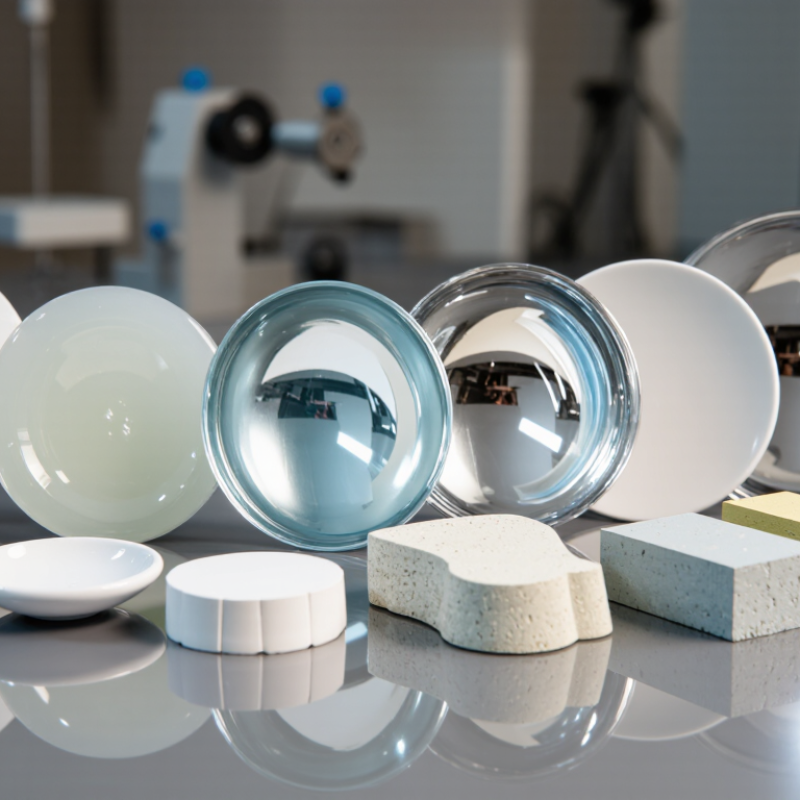
The ten common categories include polished alumina, porous alumina, zirconia, yttria, beryllia, sapphire, glazed ceramic, diffuse ceramic, multilayer-coated ceramic, and bonded ceramic composites.
Polished alumina suits many visible and near-infrared systems. Yttria and zirconia can support demanding infrared applications, but their reflectance changes with surface quality. Sapphire offers strong thermal stability and useful transmission behavior. Beryllia conducts heat well, yet it requires strict professional handling because its dust is hazardous. Diffuse ceramics spread light, while coated types target narrower wavelength bands.
Wavelength decides more than color. A reflector designed for 532 nanometers may perform poorly at 1,064 nanometers. Thermal limits also involve expansion, cooling, mounting stress, and repeated pulses. Dense ceramics generally resist heat better than porous grades, but they may crack under sudden temperature changes. I would not rank one material as universally best. That judgment is too simple. The reliable choice comes from measured reflectance, laser pulse duration, absorbed power, and the reflector’s actual temperature history. Surface inspection after testing remains essential. A clean specification sheet cannot replace that evidence.
Ceramic laser reflectors are best classified by composition, porosity, and working wavelength. The ranking is practical, not absolute. Wavelength changes everything.
Dense alumina suits ultraviolet, visible, and near-infrared systems. Porous alumina provides strong diffuse reflection for visible and near-infrared light. Zirconia performs well near infrared wavelengths and tolerates high temperatures. Magnesia offers broad visible and near-infrared reflection, but moisture can reduce stability. Spinel combines mechanical strength with useful near-infrared performance.
Yttria ceramics are valuable for infrared environments and low optical absorption. Hafnia-based ceramics can support ultraviolet applications when purity and surface finish are carefully controlled. Mullite is a cost-conscious option for visible and near-infrared thermal assemblies.
Silicon carbide handles severe heat and longer infrared exposure, although its reflectance depends strongly on surface condition. YAG-based ceramic components are used around common laser bands, especially near one micrometer, but their behavior differs from diffuse reflector ceramics.
In laboratory and production work, reflector selection requires measured data, not catalog assumptions. A polished surface may redirect light efficiently, while a porous surface spreads it more evenly. Grain size, binder content, coating thickness, and contamination can shift performance.
I have seen nominally identical samples behave differently after repeated thermal cycling. That is why engineers should verify reflectance across the actual spectrum, inspect edge heating, and test the reflector inside its intended cavity. Some classifications remain imperfect, especially when manufacturers combine ceramics or apply reflective coatings.
At 1064 nm, ceramic laser reflectors are judged by more than nominal reflectance. The main families include alumina, beryllia, YAG, porous alumina, zirconia, magnesia, steatite, cordierite, silica, and aluminum nitride. High-purity alumina remains a practical choice because it combines strong thermal stability with broad infrared scattering. Technical ceramics data commonly report diffuse reflectance above 90% for suitable white alumina grades, but surface finish changes the result significantly.
Beryllia can provide very high reflectance and excellent thermal conductivity. Some engineering data sheets report values near 95% in the near-infrared range. Its processing requires strict industrial controls, so handling and compliance costs matter. YAG behaves differently. Transparent YAG is usually a laser host, not a diffuse reflector. Polycrystalline or deliberately scattering YAG can work, but its performance depends heavily on pores, grain boundaries, and absorption losses. It is not automatically better.
Porous ceramics often produce strong multiple scattering at 1064 nm. Independent optical-ceramics studies frequently place their diffuse reflectance around 90–98%, depending on porosity and density. They can also reduce cavity alignment sensitivity. The trade-off is real: excessive porosity weakens the part and increases contamination risk. ISO 13696 measurement practice reminds engineers to separate specular and diffuse components. That distinction is frequently missed. I would not select material from one reflectance number alone. Thermal cycling, binder residue, pore size, and coating stability can change a reflector’s behavior after extended laser operation. My practical preference is dense alumina for robust systems, porous ceramic for maximum scattering, and YAG only when its optical role is clearly defined.
Typical diffuse reflectance ranges for uncoated ceramic surfaces
Porous alumina, porous silica, and porous zirconia generally provide the highest diffuse reflectance at 1064 nm because internal pores strongly scatter the laser light. Dense alumina, beryllia, YAG, spinel, aluminum nitride, boron nitride, and cordierite typically show lower uncoated-surface reflectance, while offering different thermal, mechanical, and optical properties. Actual performance depends on porosity, surface finish, purity, geometry, and measurement method.
Ceramic laser reflectors are often grouped into ten material families: alumina, beryllia, aluminum nitride, silicon carbide, yttria, zirconia, magnesia, YAG, mullite, and glass-ceramic substrates. Their performance differs sharply. A reflector exceeding 99% reflectance usually depends on a polished surface and multilayer coating, not ceramic composition alone. Published SPIE proceedings from 2022–2024 show dielectric reflector systems reaching above 99% at selected wavelengths, while off-design performance can fall quickly.
Thermal conductivity exposes the practical trade-off. Alumina typically measures 20–35 W/m·K, while aluminum nitride reaches about 140–200 W/m·K. Beryllia and silicon carbide can exceed 200 W/m·K in selected grades. Yttria, zirconia, and magnesia generally conduct heat less effectively. These figures come from technical ceramics data compiled in industry materials reports and manufacturer-independent engineering databases. They are useful, but testing temperature and porosity can change the result.
Damage threshold needs stricter inspection. Under ISO 21254 testing methods, high-quality dielectric coatings commonly report nanosecond thresholds around 5–20 J/cm², depending on wavelength, pulse duration, and defect density. Continuous-wave systems require thermal testing instead. In practical screening, I would measure reflectance at the working angle, map coating defects, and monitor a small reflector under a focused beam. The awkward point is that a 99.5% reading may look excellent, yet one microscopic inclusion can trigger failure. I would not trust a single catalog value.
| No. | Ceramic Reflector Type | Typical Laser Use | Typical Coated Reflectance at Design Wavelength | Thermal Conductivity (W/m·K, 20–25°C) | Typical Pulsed LIDT (J/cm², 1064 nm, 10 ns) | Main Advantages | Important Limitations |
|---|---|---|---|---|---|---|---|
| 1 | Aluminum Nitride (AlN) | High-power diode and fiber-laser systems | 99.0–99.9% | 140–180 | 8–20 | High thermal conductivity, low thermal expansion, electrically insulating | Machining and coating adhesion require careful process control |
| 2 | Beryllium Oxide (BeO) | High-average-power and pulsed laser cavities | 99.0–99.9% | 200–280 | 8–20 | Excellent heat spreading and good dimensional stability | Toxic dust hazard during machining; strict safety controls are required |
| 3 | Silicon Carbide (SiC) | High-power, ultraviolet, and harsh-environment optics | 99.0–99.8% | 120–200 | 6–18 | High stiffness, low mass, strong thermal shock resistance | Difficult to polish; surface quality strongly affects laser performance |
| 4 | Aluminum Oxide (Al₂O₃) | General-purpose laser cavities and beam-turning mirrors | 99.0–99.8% | 20–35 | 5–15 | Low cost, good hardness, chemical resistance, and broad availability | Lower thermal conductivity than AlN, BeO, and SiC |
| 5 | Yttrium Aluminum Garnet (YAG) | Nd:YAG and other solid-state laser resonators | 99.0–99.9% | 10–14 | 5–15 | Excellent optical quality, stable structure, and good transmission range | Moderate heat removal; coating stress can limit very high-power use |
| 6 | Magnesium Aluminate Spinel (MgAl₂O₄) | Visible, near-infrared, and rugged laser windows | 99.0–99.8% | 12–20 | 5–15 | High hardness, broad optical transmission, and good environmental durability | Lower thermal conductivity than nitride and carbide ceramics |
| 7 | Silicon Nitride (Si₃N₄) | Mechanically demanding and thermally cycled laser assemblies | 99.0–99.8% | 20–70 | 5–15 | High fracture toughness, thermal-shock resistance, and strength | Optical polish and coating uniformity may be more difficult to achieve |
| 8 | Zirconium Oxide (ZrO₂) | Compact, wear-resistant reflector components | 99.0–99.7% | 2–3 | 4–12 | Very high fracture toughness, hardness, and wear resistance | Poor thermal conductivity makes it unsuitable for severe heat loads without active cooling |
| 9 | Mullite (3Al₂O₃·2SiO₂) | Thermally stable reflector mounts and moderate-power optics | 99.0–99.7% | 4–7 | 4–12 | Low thermal expansion, good chemical stability, and cost efficiency | Limited heat-spreading capability and lower toughness than advanced ceramics |
| 10 | Cordierite (2MgO·2Al₂O₃·5SiO₂) | Low-expansion mounts and thermally stable optical supports | 99.0–99.7% | 1.5–3 | 3–10 | Very low thermal expansion, good thermal-shock resistance, and dimensional stability | Low thermal conductivity and relatively low mechanical strength |
Ceramic laser reflectors are not interchangeable. Match the material to wavelength, heat load, and cavity geometry. For Nd:YAG lasers at 1,064 nm, high-purity alumina, porous alumina, zirconia, beryllia, aluminum nitride, silicon carbide, mullite, cordierite, steatite, and machinable glass-ceramic are common design choices. Alumina offers a practical balance of reflectance and cost. Beryllia handles heat well, but requires strict engineering controls. Aluminum nitride is attractive where thermal spreading matters. Silicon carbide suits rigid, high-temperature cavities.
CO₂ lasers operate near 10.6 μm so surface finish becomes especially important. Dense alumina, zirconia, silicon carbide, mullite, and glass-ceramic reflectors can support this range when their measured reflectance is verified. Do not assume visible whiteness means infrared performance. That shortcut can cause losses. UV systems need low-contamination surfaces and stable microstructure. High-purity alumina, aluminum nitride, zirconia, and carefully finished glass-ceramic parts are more suitable than porous grades.
Fiber lasers commonly use 1,030–1,080 nm wavelengths.
Dense alumina, aluminum nitride, silicon carbide, zirconia, and beryllia can fit compact, thermally loaded cavities. Laser Focus World’s 2024 industrial market coverage places fiber lasers near half of industrial laser revenue, while Grand View Research projects double-digit growth for the broader laser technology market through 2030. Those figures support careful material selection, not automatic material substitution. Thermal drift matters. A reflector that works in a low-power test may distort after hours of operation. Spectral testing, emissivity data, and actual cavity measurements should guide the final choice.
We are here to help you with all your queries and concerns, just write to us using the below form and we will get back to you as soon as we can.