
The global search for the Top Auto Pipe Welding Machine Manufacturers Worldwide reflects a changing industrial landscape. Energy projects, shipbuilding, pressure vessels, and process plants increasingly demand repeatable pipe welds. Operators now expect stable arc control, accurate alignment, lower rework, and clear production records. A strong Auto Pipe Welding Machine must perform consistently around carbon steel, stainless steel, and alloy pipe joints.
Market evidence supports this shift. Fortune Business Insights estimates that the global welding equipment market will grow from approximately USD 14 billion in 2024 to more than USD 21 billion by 2032. Grand View Research also reports strong growth in robotic welding, driven by labor shortages and improved automation. These figures describe broad equipment categories, not pipe welding alone. Definitions differ.
That matters.
Manufacturers should therefore be compared through practical evidence, not advertising claims. Important criteria include orbital or rotational control, welding power-source compatibility, torch positioning, cooling design, travel accuracy, and service support. AWS and ISO welding standards also emphasize procedure control, qualification, and inspection discipline. These requirements separate a dependable production system from a machine that only performs well during demonstrations.
This guide examines leading manufacturers through engineering capability, application experience, automation depth, customization, and after-sales support. It also considers operator usability, spare-part availability, and performance in dusty workshops or confined fabrication areas. No ranking is perfect. A supplier may excel in stainless-steel fabrication but offer limited support for heavy-wall pipeline work. Buyers should verify test welds, references, documentation, and total ownership costs before making a final decision.
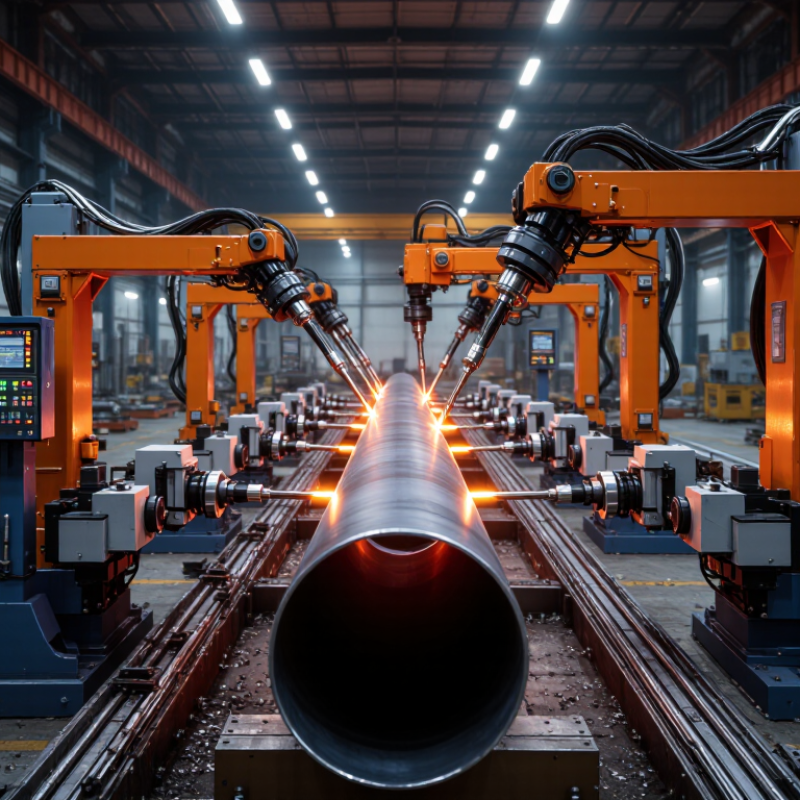
An automatic pipe welding machine is an industrial system that joins pipe sections with limited manual torch movement. It aligns, rotates, and welds the joint according to programmed parameters. Unlike a hand-held torch, it coordinates travel speed, wire delivery, shielding gas, and arc control. That control matters. Pipe diameter, wall thickness, joint design, and metal type determine the correct settings. The machine does not understand a bad fit-up.
In field workshops, operators use these machines to improve repeatability across long production runs. Clamps hold the pipe, while a turning unit maintains a steady welding position. An operator sets the welding procedure, checks the joint preparation, and observes the arc during operation. Sensors may monitor rotation speed, temperature, or weld current. These records support inspection and process traceability. Still, automation is not magic. A warped pipe, contaminated surface, or poorly prepared edge can produce defects quickly. Even experienced teams must inspect the root, fill, and cap passes.
When evaluating manufacturers worldwide, buyers should examine documented testing, operator training, spare-part support, and machine adaptability. Factory trials with actual pipe materials can reveal problems hidden in brochures. Reliable suppliers explain capacity limits instead of promising universal performance. Maintenance access also deserves attention, especially around wire feeders, clamps, and cooling lines. One detail is often missed: software settings may be precise, but practical training determines how safely they are used. A fast machine with weak technical support can become an expensive interruption.
Automated pipe welding depends on coordinated motion, stable heat, and accurate sensing. Orbital welding systems rotate the torch around the pipe while controlling travel speed and arc length. This helps produce consistent joints on repeated production runs. TIG is often selected for clean root passes, while pulsed MIG or flux-cored processes can improve filling speed. The correct choice depends on wall thickness, alloy, joint design, and required inspection standards.
Modern machines use seam-tracking sensors to detect slight misalignment before the torch travels too far. Encoders monitor rotation and position. Closed-loop controls can adjust current, voltage, and travel speed during welding. Data logging also records gas flow, heat input, and cycle time. These records support traceability and help technicians investigate defects. Still, automation is not effortless. Poor fit-up can defeat expensive controls. A perfect program cannot repair a dirty or uneven joint.
Tips: Check pipe alignment with a calibrated gauge before welding. Clean the joint area carefully. Confirm shielding-gas flow at the torch, not only at the regulator. Run a short qualification test when material or thickness changes. Watch the first production bead closely. Small errors become expensive quickly. Skilled operators should review sensor alarms instead of accepting every automatic correction. Sometimes, the machine is technically correct, but the setup is not.
The chart compares representative welding-current ranges commonly used by automated pipe-welding processes. GTAW is typically selected for precise root passes, while GMAW, FCAW, and SAW support higher deposition rates for filling and capping passes. Actual settings vary according to pipe diameter, wall thickness, material, joint design, shielding gas, and applicable welding procedures.
Comparing global auto pipe welding machine manufacturers requires more than reading speed claims. Start with the machine’s usable welding range, not its maximum brochure figure. Check pipe diameter, wall thickness, material compatibility, torch movement, and position accuracy. A machine designed for thin stainless pipe may struggle with thick carbon steel joints.
Ask each manufacturer for documented weld trials using your actual pipe samples. Measure bead width, penetration, arc stability, and heat distortion. Request procedure records, inspection reports, and repeatability data from several production cycles. Ask for evidence. A polished demonstration can hide setup difficulties.
Service capability matters just as much as engineering. Compare technician response times, operator training, spare-part availability, software updates, and remote diagnostic support across regions. Confirm electrical requirements and compliance documentation for every target market. Examine the control interface closely; clear alarms and stored parameters reduce production mistakes. Speak with current users about downtime, maintenance effort, and learning time. Their comments may reveal weaknesses that specifications omit. A spreadsheet can look precise and still mislead. Low purchase cost may become expensive when fixtures, consumables, calibration, and delayed repairs are added. Yet even this comparison is imperfect, because factory conditions rarely match a controlled test.
Choosing leading auto pipe welding machine manufacturers worldwide requires more than comparing purchase prices. Buyers should examine welding accuracy, orbital control, service coverage, and documented field experience. Pipe diameter ranges, wall thickness, joint design, and material compatibility also matter. A machine designed for stainless steel may perform differently on carbon steel or high-alloy applications.
Industry data supports this shift toward automation. The International Federation of Robotics reported 541,302 industrial robots installed worldwide in 2023. This reflects growing demand for repeatable production and reduced operator exposure. MarketsandMarkets estimates that the global welding equipment market will continue expanding through 2028, driven by infrastructure, energy, and manufacturing investment. However, reports often combine manual, robotic, and automated systems. Their figures should not be treated as exact pipe-welding demand.
Tips: Ask manufacturers for verified weld samples, cycle-time records, and maintenance response times. Check whether software supports traceability and real-time parameter monitoring. Request references from projects using similar pipe sizes and metals. A lower-cost machine can become expensive when spare parts arrive slowly.
A strong manufacturer should provide training, qualification support, and clear documentation. Factory demonstrations are useful, but they cannot replace long-term field evidence. I would also inspect calibration procedures and torch alignment personally. Marketing claims can sound precise, yet small setup errors may affect penetration and rework rates. The best choice is not always the most automated one; it is the system that fits the plant’s skills, workload, and quality controls.
| Manufacturing Region | Typical Automated Welding Processes | Common Pipe Outside-Diameter Range | Typical Wall-Thickness Capability | Automation Configuration | Applicable Qualification Standards | Typical Industries Served | Global Supply Profile |
|---|---|---|---|---|---|---|---|
| North America | Mechanized GTAW, GMAW, FCAW and SAW systems; orbital GTAW for precision pipe work | Approximately 25–1,500 mm, depending on the machine platform | Approximately 1.5–75 mm, subject to joint design and welding process | Track-mounted systems, positioners, column-and-boom equipment and multi-pass welding cells | ASME Section IX, API 1104, AWS D1.1 and ISO 15614-1 are commonly specified | Oil and gas, power generation, pressure vessels, process piping and heavy fabrication | High export activity |
| Western Europe | Orbital GTAW, mechanized GMAW, FCAW, SAW and hybrid welding solutions | Approximately 6–1,200 mm for standard industrial equipment | Approximately 1–60 mm, with specialized systems covering thicker sections | Servo-controlled positioners, robotic cells, seam tracking and digitally monitored power sources | EN 15614-1, ISO 3834, ISO 9606-1, PED-related requirements and applicable ASME codes | Petrochemical, nuclear, pharmaceutical, food processing, shipbuilding and energy equipment | High export activity |
| Central and Eastern Europe | Mechanized GMAW, FCAW, SAW and orbital welding for industrial pipe assemblies | Approximately 50–1,600 mm | Approximately 3–100 mm for heavy-duty fabrication applications | Rotary positioners, longitudinal seam systems, welding manipulators and automated flux recovery | ISO 3834, EN 15614-1, ISO 9606-1 and project-specific pressure-equipment requirements | District heating, steel fabrication, power plants, construction equipment and pipelines | Established export activity |
| East Asia | Orbital GTAW, GMAW, FCAW, SAW and robotic pipe welding systems | Approximately 6–2,000 mm, depending on the automation class | Approximately 1–120 mm across light, medium and heavy fabrication equipment | Robotic cells, multi-axis manipulators, automatic wire feeding, seam tracking and production-line integration | ISO 9001, ISO 3834, ISO 15614-1, ASME Section IX and API 1104 are frequently requested | Shipbuilding, offshore structures, construction machinery, energy equipment and industrial piping | Very high export activity |
| South Asia | Mechanized GTAW, GMAW, FCAW and SAW systems for shop and field fabrication | Approximately 25–1,500 mm | Approximately 2–80 mm, depending on the number of welding heads and passes | Portable orbital units, turning rolls, pipe positioners and semi-automatic welding stations | ASME Section IX, API 1104, ISO 3834 and ISO 15614-1 are commonly used for project qualification | Pipeline construction, boilers, pressure vessels, structural fabrication and process plants | Growing export activity |
| Southeast Asia | Orbital GTAW, GMAW, FCAW and robotic welding for repetitive pipe production | Approximately 6–1,500 mm | Approximately 1.5–75 mm | Compact orbital equipment, rotary welding stations, robotic cells and integrated production fixtures | ISO 9001, ISO 3834, ISO 15614-1, ASME Section IX and API 1104 | Shipyards, palm-oil processing, petrochemicals, food processing and general manufacturing | Strong regional supply |
| Middle East | Mechanized GMAW, FCAW, SAW and orbital GTAW for pipeline and plant construction | Approximately 50–1,800 mm | Approximately 4–100 mm for pipeline and heavy industrial applications | Field welding tractors, internal line-up systems, external welding stations and automated pipe handling | API 1104, ASME Section IX, ISO 3834 and project-specific oil-and-gas specifications | Transmission pipelines, refineries, LNG facilities, desalination and power generation | Project-driven demand |
| Latin America | Mechanized GMAW, FCAW, SAW and orbital GTAW for workshop and pipeline applications | Approximately 25–1,500 mm | Approximately 2–80 mm | Portable welding tractors, pipe rotators, positioners and semi-automatic multi-pass systems | API 1104, ASME Section IX, ISO 3834 and ISO 15614-1 | Mining, oil and gas, hydropower, steel fabrication and industrial maintenance | Regional and project-based supply |
| Capability ranges are representative industrial specifications rather than rankings of individual companies. Actual performance depends on pipe material, diameter, wall thickness, joint preparation, welding procedure, positioner capacity, heat input limits and required inspection level. Manufacturer qualification should be verified against the applicable project standard before purchase. | |||||||
Auto pipe welding machines now serve oil and gas lines, water infrastructure, shipyards, power plants, and prefabricated process skids. Their value depends on more than travel speed. Stable arc control, precise fit-up, repeatable heat input, and field service support matter equally. The International Federation of Robotics reported 541,302 new industrial robots installed worldwide in 2023. This growth signals wider automation across heavy manufacturing. Deloitte and The Manufacturing Institute also forecast up to 2.1 million unfilled manufacturing jobs by 2030. Pipe welding automation may reduce repetitive exposure, but it cannot replace skilled judgment during poor alignment or changing site conditions.
Future development will center on sensor-guided welding, digital twins, remote monitoring, and adaptive control. Cameras and laser scanners can detect joint gaps before defects become expensive. Data platforms may compare amperage, travel speed, shielding gas flow, and temperature in real time. Yet the data is often incomplete. A reflective pipe surface can still confuse a sensor. Human inspection remains necessary. Lower-energy power sources and improved wire efficiency may also support cleaner fabrication, especially in large-volume plants.
Ask manufacturers for documented weld procedure qualification records, not only speed claims. Test the machine on your actual pipe diameter, wall thickness, alloy, and joint design. Check maintenance access, operator training, and spare-part response times. A short factory demonstration is useful, but a supervised field trial reveals more.
We are here to help you with all your queries and concerns, just write to us using the below form and we will get back to you as soon as we can.