
China’s battery equipment sector has become a major force in cylindrical cell production. This guide examines China’s Top 10 Cylindrical Cell Assembly Machine Suppliers through practical manufacturing criteria. These criteria include equipment accuracy, production speed, automation depth, safety controls, after-sales service, and documented customer experience.
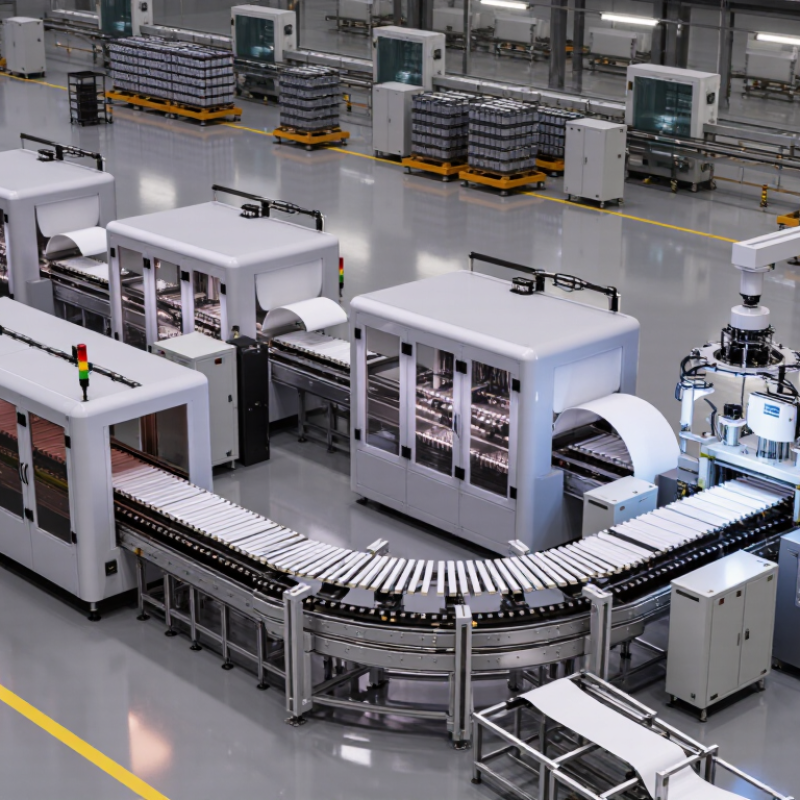
Cylindrical Cell Assembly Machines support several demanding stages. These stages may include electrode feeding, winding, tab welding, shell insertion, electrolyte filling, sealing, and end-of-line inspection. A reliable line should maintain stable alignment while handling thin separators and delicate electrode materials. Even a small welding defect can reduce cell performance or create safety concerns. Battery researcher Jeff Dahn has said, “The battery is the most important component in an electric vehicle.” His observation explains why assembly quality deserves close attention.
This supplier overview does not treat company size as proof of technical excellence. It considers factory demonstrations, engineering documentation, certification records, delivery capability, and measurable production results. Some suppliers offer highly automated lines with robotic transfer and vision inspection. Others provide flexible systems better suited to pilot production or changing cell designs. That difference matters.
No ranking is perfect. Supplier information can change quickly. Published specifications may also appear stronger than real factory performance. Buyers should request sample testing, acceptance criteria, maintenance plans, and spare-parts support before signing contracts. A machine may look impressive on paper. It must still perform consistently beside operators, welding stations, and inspection equipment. This article offers a practical starting point for comparing leading Chinese suppliers, while encouraging deeper technical verification.
China’s cylindrical cell market is shaped by three practical formats: 18650, 21700, and 4680. Each size changes machine design, tooling, and production rhythm. For 18650 lines, compact feeding systems and precise tab welding are essential. Their smaller diameter allows dense module layouts, but alignment errors quickly affect pack quality.
The 21700 format needs stronger handling equipment and wider process tolerances. Suppliers should provide stable cell loading, insulation placement, laser or resistance welding, and electrical testing. In factory trials, I would inspect weld consistency after repeated changeovers, not only during a short demonstration. Small details matter. A loose fixture can create hidden defects.
The 4680 format creates a different engineering challenge. Its larger body requires heavier clamping, improved thermal control, and more careful inspection around the current-collection structure. Machine suppliers should explain how their equipment manages dimensional variation, traceability, and emergency stops. Data access also matters; operators need clear records for voltage, resistance, weld energy, and rejected cells. No supplier is perfect. Some specifications look convincing, yet real output may decline after several hours. A reliable evaluation should include sample production, maintenance response, spare-part availability, and format conversion time. Chinese equipment manufacturers can offer flexible customization, but buyers should verify claims through factory acceptance tests and measured production data.
China Top 10 Cylindrical Cell Assembly Machine Suppliers
Cylindrical cell assembly demands controlled movement, clean handling, and repeatable pressure. The International Energy Agency reported that global electric vehicle battery demand exceeded 750 GWh in 2023, rising about 40%. This growth increases pressure on equipment suppliers and production engineers.
The process begins with electrode tab welding and shell insertion. Weld strength must remain stable without damaging the separator. Electrolyte filling follows under vacuum, because trapped gas can create swelling or poor wetting. Sealing then protects the cell from moisture. Formation slowly charges and discharges each cell, activating its chemistry. Aging exposes voltage drift, leakage, and abnormal self-discharge. It is a quiet stage. It still matters.
Tips: Check weld resistance, filling weight, sealing height, and chamber pressure with traceable instruments. The U.S. Department of Energy emphasizes process control and quality monitoring for advanced battery manufacturing. In practice, a fast line is not always a good line. Small variations may remain hidden until formation. Some teams also underestimate aging time, especially when production targets change. That is a mistake worth reviewing. Machine suppliers should provide data logging, recipe control, safety interlocks, and maintenance access. The sequence looks simple on paper, but thermal behavior, electrolyte viscosity, and cell dimensions can change across batches. Engineers should validate every setting with real production samples, not only factory acceptance tests.
This chart shows representative industrial durations for key cylindrical lithium-ion cell assembly stages. Welding, electrolyte filling, and sealing are usually completed within seconds or minutes, while formation and aging require substantially longer controlled time. Actual parameters vary according to cell format, chemistry, equipment configuration, and quality requirements.
China’s top 10 cylindrical cell assembly machine suppliers should be ranked by verified production results, not brochure claims. The evaluation uses UPH, OEE, yield, and automation depth as core measures. IEA’s Global EV Outlook 2024 reported more than 750 GWh of global EV battery demand in 2023. China represented roughly 60% of that demand, increasing pressure on stable, high-speed assembly lines.
UPH receives a 30% weighting, based on sustained output during factory acceptance testing.
OEE receives 25%, measured across availability, performance, and quality during a 72-hour production run.
Yield contributes another 25%, with first-pass yield preferred over reworked output.
The remaining 20% measures automation depth, including robotic loading, vision inspection, traceability, recipe control, and closed-loop fault handling. Short trials can mislead.
The strongest suppliers combine high UPH with controlled downtime and consistent weld quality. A machine reaching 180 cells per minute may underperform if changeovers consume every afternoon.
Industry benchmarking from Benchmark Mineral Intelligence repeatedly highlights yield improvement and process automation as major cost levers in battery manufacturing. However, supplier-specific OEE data remains difficult to audit publicly. This ranking therefore favors witnessed tests, customer references, and signed acceptance records. The method is practical, but not perfect. Some factories still report optimistic numbers.
China Top 10 Cylindrical Cell Assembly Machine Suppliers
A serious supplier profile should begin with cell compatibility. Common machines support 18650, 21700, and 4680 formats, but tooling changes can affect delivery time. Check diameter, height, tab position, and electrolyte handling requirements. Some suppliers quote wide ranges, yet their standard fixtures may support only one cell family. That difference matters.
Machine accuracy deserves measured evidence, not polished claims. Ask for placement tolerance, welding repeatability, inspection speed, and recorded test results. A practical target may include ±0.1 mm positioning accuracy and stable weld energy across long production runs. During factory evaluations, buyers should inspect sample cells under magnification. Small burrs or uneven weld marks can reveal process weakness. Brochures cannot show everything.
Safety systems should include guarded motion areas, emergency stops, door interlocks, smoke detection, and controlled access to electrical cabinets. Compliance with recognized standards, such as ISO 12100 and IEC 60204-1, should be supported by documented testing. Service quality is equally important. Confirm installation training, spare-parts availability, remote diagnostics, and response times across different time zones. Some suppliers provide excellent commissioning but weaker follow-up support. That risk is easy to overlook. No supplier gets every detail right, so a pilot run and acceptance checklist remain essential.
| Profile | Typical Supplier Focus | Compatible Cylindrical Cell Sizes | Assembly Processes | Typical Positioning Accuracy | Relevant Safety Standards | Service and Support Coverage | Recommended Application |
|---|---|---|---|---|---|---|---|
| Profile 01 | High-volume automated pack-line integrator | 18650, 21700, 26650; format change through dedicated tooling | Cell sorting, loading, insulation placement, welding, testing, labeling | Up to ±0.10 mm at the tooling station | ISO 12100 risk assessment; IEC 60204-1 electrical equipment; CE-oriented safeguarding; interlocked doors and emergency stops | Line layout, factory acceptance testing, installation training, remote diagnostics, spare-parts planning | Large-volume power-tool and light-EV battery packs |
| Profile 02 | Flexible automatic cylindrical-cell assembly specialist | 18650, 21700, 32700; servo-adjusted guides and fixtures | Sorting, tab or nickel-strip welding, end insulation, polarity inspection | Typically ±0.05–0.10 mm, depending on station | ISO 12100; IEC 60204-1; CE marking support; laser-welding enclosure and fume extraction provisions | Changeover assistance, recipe setup, operator training, preventive-maintenance guidance, video support | Mixed-batch production and contract manufacturing |
| Profile 03 | Laser-welding and electrical-test equipment supplier | 18650, 21700, 26650, 32700 | Cell positioning, laser or resistance welding, weld inspection, continuity testing | Approximately ±0.05 mm for precision welding fixtures | ISO 12100; IEC 60204-1; laser safety controls aligned with IEC 60825-1; guarding and access interlocks | Weld-parameter development, sample validation, process documentation, calibration support, technician training | High-consistency industrial and automotive subassemblies |
| Profile 04 | Semi-automatic pilot-line equipment builder | 18650, 21700, 26650; manual or pneumatic format adjustment | Manual loading, pneumatic clamping, spot welding, basic resistance and polarity checks | Typically ±0.10–0.20 mm | ISO 12100 principles; IEC 60204-1 practices; emergency-stop circuits; electrical overload protection | Application consultation, operator training, commissioning, maintenance manuals, consumables support | R&D, pilot production, universities, and small-batch assembly |
| Profile 05 | Busbar, nickel-strip, and module interconnection specialist | 18650, 21700, 32700, 4680 with application-specific fixtures | Busbar forming, strip feeding, welding, insulation, dimensional and electrical inspection | Approximately ±0.10 mm for automated placement | ISO 12100; IEC 60204-1; CE-oriented guarding; smoke or fume extraction for welding operations | Tooling design, sample builds, line balancing, commissioning, spare feeder and welding-part support | Battery modules, energy-storage systems, and industrial packs |
| Profile 06 | Inspection and traceability-focused assembly supplier | 18650, 21700, 26650, 32700 | Barcode reading, OCV and internal-resistance checks, sorting, welding, data logging | Typically ±0.10 mm; electrical-test accuracy depends on instruments | ISO 12100; IEC 60204-1; ESD-control practices; software access control and safety interlocks | MES or PLC communication support, traceability configuration, calibration records, remote troubleshooting | Quality-sensitive production requiring cell-level records |
| Profile 07 | Compact battery-pack machinery provider | 18650, 21700; optional tooling for 26650 | Cell loading, arrangement, spot welding, BMS wiring assistance, pack testing | Typically ±0.15 mm | ISO 12100; IEC 60204-1; low-voltage electrical protection; emergency-stop and over-temperature monitoring | Standardized machine options, online commissioning, user manuals, replacement-part quotations | Consumer electronics, mobility products, and workshop-scale production |
| Profile 08 | Large-format cylindrical-cell handling specialist | 32700, 40135, 4680; tooling is generally size-specific | Large-cell feeding, orientation, clamping, busbar placement, welding, inspection | Approximately ±0.15 mm, depending on cell diameter and fixture design | ISO 12100; IEC 60204-1; guarded moving parts; welding enclosure; extraction and thermal monitoring provisions | Custom engineering, trial production, mechanical integration, on-site commissioning, process optimization | Energy storage, electric mobility, and high-capacity industrial modules |
| Profile 09 | Modular production-line and robotic integration supplier | 18650, 21700, 26650, 32700; robotic end-effectors are cell-specific | Robotic picking, vision inspection, welding, module assembly, end-of-line testing | Robot repeatability commonly specified around ±0.05–0.10 mm | ISO 12100; IEC 60204-1; ISO 10218 robot-safety principles; perimeter guarding and safety scanners | Factory simulation, robot programming, integration testing, production ramp-up, lifecycle support | Highly automated lines with multiple process stations |
| Profile 10 | Export-oriented turnkey equipment supplier | 18650, 21700, 26650, 32700; custom tooling available for other cylindrical formats | Cell grading, assembly, welding, insulation, pack testing, labeling, and documentation | Typically ±0.10–0.20 mm, subject to machine configuration | ISO 12100; IEC 60204-1; CE technical-file support; electrical protection, guarding, interlocks, and emergency stops | Turnkey project management, English documentation, FAT and SAT support, installation, training, warranty and spare parts | Overseas factories seeking a complete line package |
Note: The profiles are anonymized and represent common supplier capability categories in China’s cylindrical-cell assembly-machine market. Accuracy values are typical specification ranges and should be confirmed through the supplier’s technical proposal, sample testing, factory acceptance test, and final machine configuration. IEC 62133-2 and UN 38.3 apply primarily to battery-product safety and transport testing rather than directly certifying the assembly machine.
A serious buyer should score more than brochure speed. The IEA’s Global EV Outlook 2024 reports that electric vehicle battery demand exceeded 750 GWh in 2023, rising about 40% year on year. That growth increases pressure on cylindrical cell assembly lines. Ask suppliers for verified cycle time at your target format, not a laboratory maximum. Measure cells per minute, changeover time, and uptime during a continuous pilot run. Small delays compound quickly.
Traceability must follow every cell through feeding, welding, inspection, and testing. Record batch numbers, weld current, force, temperature, vision images, and timestamps. The U.S. Department of Energy’s battery manufacturing guidance emphasizes process control, quality data, and domestic supply-chain resilience. A useful audit checks whether operators can retrieve one defective cell’s complete history within minutes. If data export requires manual spreadsheets, the system is not truly traceable.
Scrap rate needs a clear denominator. Separate material loss, startup scrap, process rejects, and rework. Benchmark the result after stabilization, not during the first shift. Payback should include labor, consumables, maintenance, rejected cells, and production downtime. Use this formula: investment divided by annual verified savings. A three-year payback may look acceptable, but volatile yields can distort it. I would request references, raw trial data, and a contractual acceptance test. Published figures are useful. They are not proof.
We are here to help you with all your queries and concerns, just write to us using the below form and we will get back to you as soon as we can.