Global buyers comparing top Automotive Motor Tester suppliers need more than a polished product page. They need equipment matched to motor type, test voltage, duty cycle, and production volume. A compact bench tester may suit a repair workshop, while a busy factory may need automated testing, clear data exports, and integration with existing lines. The right choice depends on the actual work.
Look closely at test repeatability, measurement ranges, calibration documentation, operator training, and service response times. Ask suppliers how their systems handle a failed test, a motor with unusual noise, or a sudden change in production demand. A specification sheet cannot answer every question. Small details matter.
Quality expert W. Edwards Deming’s well-known reminder, “In God we trust; all others must bring data,” offers a useful lens for evaluating test equipment. Applied to an Automotive Motor Tester, it means asking for evidence: sample reports, validation methods, and realistic demonstrations using representative motors. Deming was not a motor-tester supplier, so his principle should not replace hands-on technical review. It does, however, underline a practical point: trust should be supported by measurable results. Real support matters.
This guide introduces suppliers serving international buyers and the factors that distinguish their offerings. Compare capabilities carefully, and confirm service coverage for your location before purchasing. Some supplier claims may sound alike. That is worth questioning.
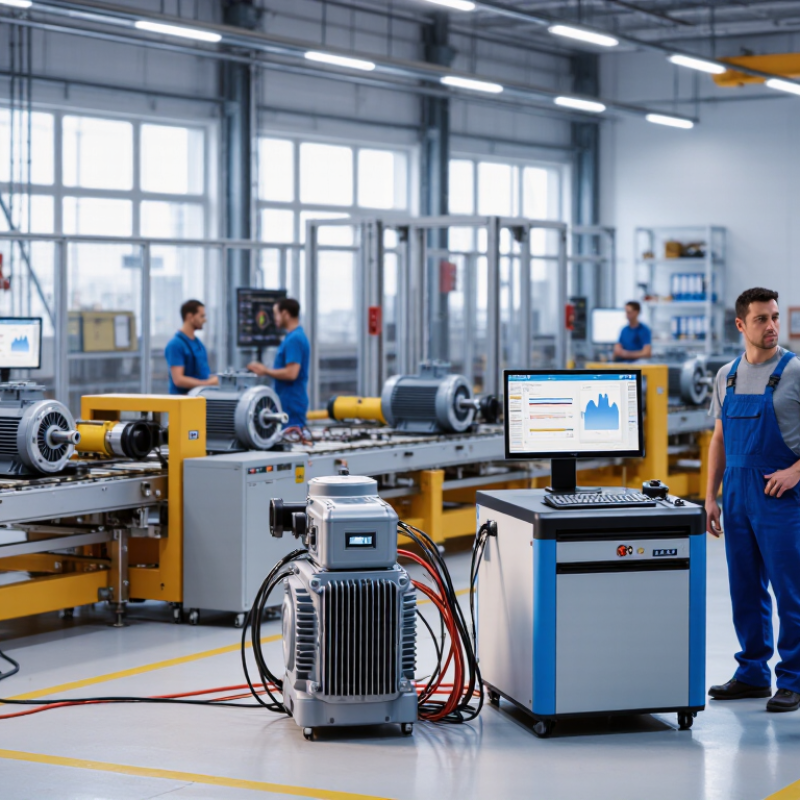
Automotive motor testers generally fall into three groups: dynamometers, bench systems, and end-of-line stations. A dynamometer applies load while a motor runs, measuring torque, speed, power, and often temperature. It helps engineers map performance across operating points, rather than merely checking whether a motor turns. Fixtures must hold the unit securely, while cooling and guarding should suit the test duty. Heat matters. A brief run can look normal, yet a longer cycle may reveal drift.
Bench testers typically check defined electrical or mechanical characteristics under controlled conditions. They are useful for repeatable development work and fault investigation, especially when engineers need clear measurements at specific terminals. End-of-line systems test motors during production, often combining automated connections, short functional checks, and recorded pass-or-fail results. Cycle time matters here, but rushing setup verification can create misleading data. Details count. For global buyers, supplier evaluation should cover calibration records, fixture changes, data-export options, operator training, and access to technical support across time zones. Ask how the system handles a failed test and preserves the raw measurements; the answer may expose gaps that a polished demonstration will not.
Global buyers should judge automotive motor testers by the quality of their measurements, not by a long feature list. The IEA’s Global EV Outlook 2024 reports nearly 14 million electric cars sold in 2023, around 18% of global car sales. That growth makes repeatable motor validation increasingly important.
Torque and speed define the operating curve; together, they determine mechanical output power. A useful test setup records these values across low, rated, and peak-speed points, rather than capturing one impressive peak. Efficiency requires comparing electrical input with mechanical output under stated conditions. IEC 60034-2-1 provides recognized methods for determining motor efficiency. Temperature matters too: sensor placement, ambient conditions, and test duration can change readings. One caveat: a tidy report does not guarantee a reliable measurement; calibration and stated uncertainty deserve scrutiny.
Tips: Ask suppliers for sample data showing torque, speed, power, efficiency, and winding or housing temperature on the same run. Check repeatability across runs. Small inconsistencies can be revealing. Peak values are useful, but continuous-load results often better reflect real operation.
Representative five-point motor bench-test profile. Each series is indexed to its own maximum so torque, speed, power, efficiency, and temperature trends can be compared on one chart.
Example test values: torque 48–240 N·m; speed 2,850–2,980 rpm; output power 15.0–71.6 kW; efficiency 86–95%; winding temperature 35–96°C. Power values are consistent with torque and speed using P (kW) = torque (N·m) × speed (rpm) ÷ 9,549. Actual results depend on the motor, test setup, and thermal conditions.
For global buyers, an automotive motor tester should support repeatable efficiency measurements, not just display power and speed. IEC 60034-2-1 describes methods for determining losses and efficiency in rotating electrical machines. IEEE 112 provides test procedures for polyphase induction motors and generators. The methods are not interchangeable in every case; the machine type and selected procedure matter.
A capable test system should capture electrical input, mechanical output, speed, torque, and relevant temperatures. During a witnessed test, engineers may check that winding temperature has stabilized before recording results. Small errors matter. A misaligned coupling or poorly calibrated torque sensor can distort calculated efficiency. Buyers should ask suppliers which standard edition and test method their system supports, and request sample reports with uncertainty and calibration details.
The comparison can get messy. Different methods treat losses differently, so results may not match without careful alignment of test conditions. A supplier’s claim of “IEC and IEEE compliant” needs specifics: applicable motor classes, measurement range, and documented procedures. Test those details against your own acceptance criteria. Paper compliance alone is not enough. A practical evaluation should include a representative motor, repeat runs, and a review of raw data. Even then, fixture effects deserve another look.
With electric-car sales reaching nearly 14 million in 2023, or about 18% of global car sales, test capacity must keep pace. The International Energy Agency reports these figures in its Global EV Outlook 2024. For buyers comparing motor-test platforms, “400 V and 800 V coverage” should mean more than a voltage rating on a datasheet. The system must accommodate the inverter, motor, and measurement chain at the intended operating points. Check continuous and peak power, current range, measurement bandwidth, and insulation ratings. Ask for test records at both voltage levels, not just a statement of compatibility. Details matter.
An 800 V setup can reduce current for a given power level, but it also raises demands on insulation coordination and safe measurement practices. A useful supplier discussion starts with the actual test plan: motor speed, torque, regenerative operation, cooling method, and duty cycle. Can the dynamometer hold a low-speed torque point steadily, then capture a fast inverter transient? What changes when the DC bus moves from 400 V to 800 V? A test cell should answer those questions with documented limits and repeatable procedures. Paper specifications help. Real operating data helps more. Even then, some integration assumptions may prove wrong; cable routing and thermal behavior are easy to underestimate.
Buyer comparison matrix: This table summarizes practical platform requirements for evaluating suppliers; it does not rank or describe any specific company. Voltage class alone does not define a system’s operating limits. Confirm each platform’s rated and maximum voltage, current, power, speed, accuracy, and safety documentation directly with the supplier.
| Platform profile | Drive voltage coverage | Motor and inverter coverage | Core test capabilities | Evidence to request from suppliers | Best-fit buyer need |
|---|---|---|---|---|---|
| 400 V-class motor test platform | Designed for EV drive systems built around a nominal 400 V DC-link class. Confirm the allowed DC input range and transient limits for the complete test setup. | Typically configurable for permanent-magnet synchronous motors (PMSMs) and induction motors, subject to the dynamometer, inverter interface, and control options selected. | Torque–speed mapping, efficiency measurement, inverter–motor testing, thermal performance checks, and regenerative operation where supported. | Rated and peak power and torque; continuous and maximum speed; measurement uncertainty; cooling requirements; inverter compatibility; and test-cell safety documentation. | Programs focused on 400 V-class passenger-vehicle or commercial-vehicle drives, component development, and production validation. |
| 800 V-class motor test platform | Designed for EV drive systems built around a nominal 800 V DC-link class. Verify the platform’s voltage rating, insulation coordination, and measurement limits for the intended test envelope. | Supports testing of motors and inverters intended for higher-voltage EV architectures when the selected power electronics, sensors, cabling, and protection system are appropriately rated. | Drive-cycle testing, efficiency mapping, high-voltage inverter evaluation, regenerative testing where supported, and thermal characterization. | Maximum DC voltage and current; voltage and current sensor ratings; isolation and interlock design; grounding scheme; fault-response behavior; and documented operating procedures. | Programs developing or validating higher-voltage EV propulsion systems and components. |
| Dual-voltage 400 V / 800 V platform | Configurable for both voltage classes when the system’s declared voltage and power limits cover each required test condition. Dual-voltage capability should not be assumed from a product description alone. | Can serve mixed motor and inverter programs if the dynamometer, power electronics, instrumentation, and control software meet the requirements of each configuration. | Repeatable comparative tests across drive variants, parameterized test sequences, efficiency maps, and automated data capture. | Written confirmation of supported configurations; changeover procedure; configuration control; calibration traceability; and whether separate hardware or accessories are required. | Engineering teams testing multiple EV platforms or planning to expand from 400 V-class to 800 V-class programs. |
| High-speed motor test configuration | Available in 400 V-class, 800 V-class, or other configurations depending on the selected electrical equipment and system ratings. | Suitable for motor designs whose maximum operating speed, rotor construction, and coupling requirements are within the specified limits of the dynamometer and test fixture. | Speed sweeps, torque measurement over the operating range, vibration monitoring when configured, and overspeed-related validation procedures. | Maximum continuous and short-duration speed; rotor containment provisions; coupling limits; balancing requirements; vibration measurement capability; and test-cell risk assessment. | Programs where maximum motor speed, rotor integrity, or high-speed operating behavior is a primary validation concern. |
| Production-oriented motor test system | Configured to the voltage class and electrical test requirements of the production motor or drive unit; confirm whether the system tests a motor, inverter, or assembled e-drive. | May be configured for end-of-line checks on a defined product family, with interfaces and fixtures tailored to the production process. | Automated test sequencing, electrical and functional checks, result logging, limit evaluation, and integration with factory systems where supported. | Test time per unit; fixture changeover; repeatability; traceable calibration; data-export formats; production-system interfaces; and maintenance requirements. | Manufacturers seeking repeatable, automated checks for production quality control rather than broad research flexibility. |
| Flexible R&D motor test bench | Specified by the buyer’s required bus-voltage range, power level, and measurement equipment; verify each item as a complete system rather than as a standalone component. | Often selected for development work across motor types, control strategies, and inverter configurations, within the limits of the installed hardware and software. | Custom operating points, engineering experiments, efficiency characterization, control development, and configurable data acquisition. | Available control modes; software access; measurement channels; data-sampling specifications; expansion options; calibration services; and technical support scope. | Research, prototype development, and validation teams that need adaptable test procedures and configurable instrumentation. |
Choosing an automotive motor tester starts with accuracy under real shop conditions. Ask suppliers for measurement ranges, repeatability data, and test results across different motor loads. A stable reading on a bench is useful; a stable reading after hours of operation is more convincing. Check how the system handles temperature changes, electrical noise, and unusual vibration. Small details matter.
Automation should reduce operator variation, not conceal it. Review the test sequence, safety interlocks, data export options, and fault alerts before purchase. A practical demonstration might include a motor with a known winding fault and show how the tester records the result. Ask whether operators can adjust recipes without changing protected settings. Software looks polished. The workflow may still be awkward.
Calibration and service support deserve equal attention. Request the calibration interval, adjustment procedure, and documentation supplied with each instrument. Confirm whether calibration can be performed locally, and how quickly replacement parts or remote troubleshooting are available in your region. Service promises are easy to make; response times are harder to verify. Speak with current users, if possible, and ask about delayed support or unclear manuals. No supplier is perfect, and a minor interface issue may matter less than reliable measurements and accessible technical help. Make the trade-off explicit before comparing quotations.
We are here to help you with all your queries and concerns, just write to us using the below form and we will get back to you as soon as we can.