Choosing a water service pump is rarely as simple as comparing horsepower or price. A unit that performs well in a clean-water test may struggle with grit, frequent starts, or a long discharge line. Small details matter: pipe diameter, required flow, total head, seal type, and the quality of the local power supply. They shape everyday performance.
This guide reviews ten options for global buyers, with attention to practical fit rather than a single “best” choice. It considers common applications, construction materials, energy use, maintenance access, and manufacturer support. Check the duty point against your actual system. A pump running far from its efficient range can waste energy and wear sooner. Not glamorous, but important.
Specifications are not always presented in the same way. Regional voltage, test methods, and available certifications can differ, so confirm current details with the manufacturer or authorized supplier before ordering. Also ask about spare seals, impellers, and service response in your market. A low purchase price can look less attractive when parts take weeks to arrive. There is no perfect ranking for every site; water quality and installation conditions can change the result. Use this shortlist as a starting point, then verify each model against your operating needs.
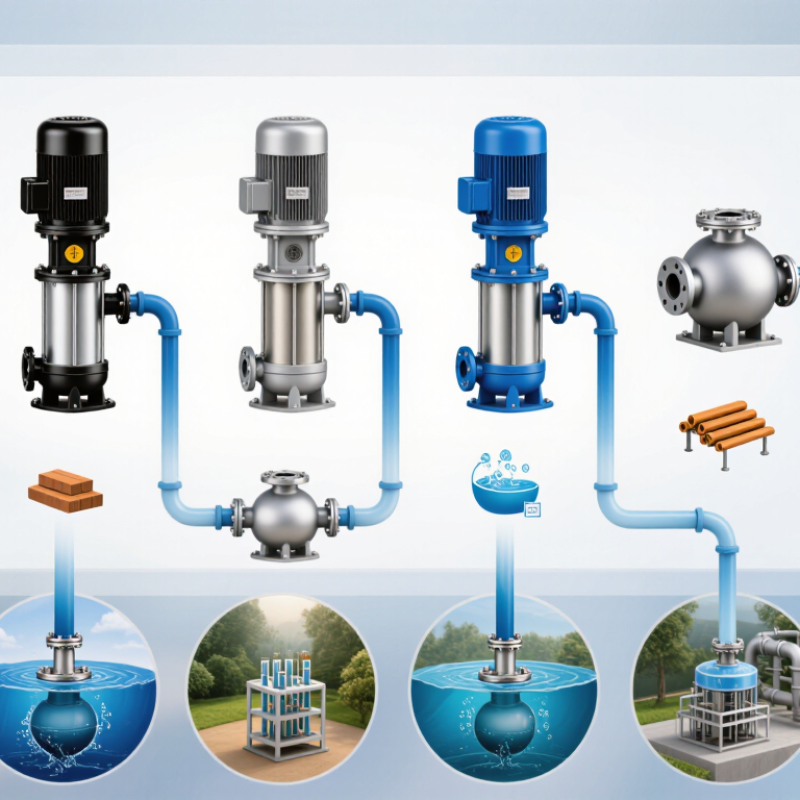
For water-service pumps, define the duty point before comparing models: required flow at the total head, not maximum flow or shut-off head alone. Head includes elevation, pressure needs, and friction losses through pipes, valves, and filters. Measure or calculate these values for the real operating route. A narrow pipe run can add more resistance than expected. The U.S. Department of Energy’s Improving Pumping System Performance sourcebook notes that pumping systems use a substantial share of industrial electricity, making duty-point accuracy an energy issue, too. Bigger is not automatically better.
Specify how performance will be verified. ISO 9906:2012 sets acceptance-test grades and tolerances for rotodynamic pump performance; the selected grade should match the project’s risk, measurement capability, and contract requirements. Request test results for flow, head, and power at agreed conditions, and clarify whether the test uses the supplied pump or a representative configuration. A tighter grade can improve confidence, but it may require more precise testing. Check the operating range as well as the single rated point. Real demand fluctuates. One imperfect step is treating a calculated head as exact; revisit it after confirming pipe lengths, fittings, and water-level changes.
Compare 10 Pump Types by Design, Duty, and Water-Handling Capability
Pump selection starts with the water, not the catalog. The International Energy Agency’s 2016 report, The Future of Water, estimates that water services use about 4% of global electricity. That makes duty matching important: flow, head, solids, and operating hours all affect performance. End-suction and split-case centrifugal pumps suit general transfer and high-flow duties. Multistage pumps provide higher pressure, while submersible and vertical-turbine designs serve wells, sumps, and deep intakes. Axial-flow pumps move large volumes at low head; mixed-flow models balance flow and pressure. Self-priming pumps can help where suction lines drain between cycles. Not interchangeable.
For tougher fluids, diaphragm pumps handle intermittent dosing and some suspended solids, while progressive-cavity pumps move viscous or solids-laden water at controlled flow. These are not universal sewage solutions; check particle size, abrasiveness, and maintenance access.
The UN World Water Development Report 2024 notes that agriculture accounts for roughly 70% of freshwater withdrawals worldwide, highlighting the scale of irrigation demand. For irrigation, compare axial-flow, mixed-flow, and centrifugal options against the actual lift and required discharge. A simple field check matters: measure pressure at the outlet, then compare it with the pump curve. Real sites are messier than a catalog suggests. A pump that handles clean water may struggle when grit, air, or changing water levels enter the picture.
A water service pump should be judged at its actual duty point, not by its highest advertised efficiency. Compare flow, head, and power input on the same performance curve. A pump operating far from its best-efficiency point may use more energy and experience greater vibration. Small details matter. Check the impeller diameter and speed used for each quoted curve.
NPSH deserves equal attention. Compare the system’s available NPSH with the pump’s required NPSH at the expected flow, then allow a practical margin. Suction lift, warm water, long pipe runs, and clogged strainers can reduce that margin. Cavitation may sound like gravel in the casing. It can also damage the impeller. A tidy catalogue figure cannot account for every site condition.
Use ISO 9906 test results to assess whether measured flow, head, and efficiency fall within the specified acceptance grade and tolerances. Confirm the test conditions and acceptance level before comparing suppliers; grades are not interchangeable shorthand for “better.” Request the full curve and a test report for the selected operating range. Even good test data has limits. I would still question a result that looks unusually perfect, especially when field piping and water temperature differ from the test setup.
| Pump configuration | Typical water-service duty | Indicative flow range (m³/h) |
Indicative head range (m) |
Typical peak hydraulic efficiency | Indicative NPSHr at rated duty (m) |
ISO 9906 evaluation focus |
|---|---|---|---|---|---|---|
| Horizontal split-case, double-suction | Municipal waterworks, transfer, and large distribution systems | 50–3,000 | 10–160 | 70–88% | 2–8 | Confirm tested flow, head, and power at the specified duty point; review the complete performance curve. |
| End-suction, single-stage | General water transfer, treatment plants, and building services | 5–500 | 5–100 | 55–82% | 1.5–6 | Compare the certified test results with the contractual ISO 9906 acceptance grade and tolerances. |
| Horizontal multistage | High-pressure clean-water transfer, filtration, and industrial supply | 1–200 | 30–500 | 50–82% | 1.5–6 | Check head and absorbed power across the specified operating range, not only at shutoff or peak efficiency. |
| Vertical turbine | Wells, reservoirs, river intakes, and water-treatment intakes | 20–5,000 | 10–300 | 65–88% | 2–8 | Verify the tested assembly and duty point; account for bowl stages, column losses, and installation conditions. |
| Submersible borehole | Groundwater abstraction and deep-well supply | 1–300 | 20–350 | 45–80% | Not typically stated as a conventional suction NPSHr; check minimum submergence and inlet conditions. | Request a performance test for the pump configuration and check flow, head, and power against the agreed acceptance criteria. |
| Vertical inline, single-stage | Building circulation, HVAC, and pressurized water systems | 5–500 | 5–100 | 50–82% | 1.5–6 | Assess performance at the required system flow and head; confirm the stated test basis and measurement uncertainty. |
| Self-priming centrifugal | Intermittent transfer and installations where the pump is above the water source | 5–300 | 5–50 | 40–75% | 2–7 | Evaluate steady-state hydraulic performance separately from priming capability and priming time. |
| Axial-flow | Flood control, drainage, and high-volume, low-head water transfer | 500–20,000+ | 1–20 | 70–88% | 2–8 | Use a test curve covering the intended flow range; check operation against the system curve and specified acceptance grade. |
| Mixed-flow | Irrigation, cooling-water circulation, and medium-head transfer | 50–5,000 | 5–80 | 65–88% | 2–8 | Compare measured flow, head, and power at the contractual test point and confirm the agreed tolerance limits. |
| Packaged variable-speed booster set | Building and distribution networks with changing demand or pressure requirements | 5–1,000 | 20–200 | 50–85% (pump hydraulic efficiency; system efficiency varies) | 1.5–6 per pump, depending on duty | Test the pump at defined operating points; assess controls and package performance separately from the pump acceptance test. |
Note: Figures are indicative engineering ranges for common pump configurations, not guaranteed specifications for a particular pump. Actual flow, head, efficiency, and NPSHr depend on pump size, impeller, speed, fluid, and operating point. NPSHr must be checked against available NPSH with an appropriate margin. ISO 9906 compliance is established by testing a defined pump against the acceptance grade and tolerances agreed for the purchase; it cannot be inferred from a pump category alone.
For water-service pumps, material selection starts with water chemistry, not price alone. Clear water may still contain chlorides, grit, or dissolved oxygen. The U.S. EPA sets 250 mg/L as the secondary drinking-water standard for chloride. This is an aesthetic benchmark, not a universal corrosion limit. Treat it as a screening clue, then test water near the pump. Small differences matter.
For low-chloride municipal water, coated ductile iron casings may be suitable. Stainless steel impellers can help where corrosion and abrasion risks increase. Brackish water needs closer review: compare alloy grades against chloride levels, temperature, pH, and stagnant periods. A warm casing or stagnant seal chamber may face harsher conditions than an intake sample suggests. Do not assume. NACE’s 2016 IMPACT study estimated global corrosion costs at US$2.5 trillion, or 3.4% of global GDP, and reported potential savings of 15–35% through corrosion-control practices.
Choose seals by chemical compatibility and temperature, not by a generic “water service” label. EPDM can suit many water applications; oil traces or disinfectants may change the choice. Check seal-face materials and flushing needs against suspended solids and dry-running risk. Record leakage, water temperature, and seal operating hours during inspections. A tidy spreadsheet is not enough; field conditions can be messy.
For a water-service pump, frequency affects motor speed and the flow a system can deliver. A four-pole motor has a synchronous speed of 1,500 rpm at 50 Hz and 1,800 rpm at 60 Hz; actual speed is slightly lower. That difference can change pressure, flow, and energy use. Check the pump curve at the supply frequency, not just the pipe connections. One detail is easy to miss.
Voltage matters just as much. Compare the motor nameplate with the site’s measured supply, and confirm that the starter, protection, and cable suit both the voltage and frequency. IEC 60034-1 sets operating requirements for rotating electrical machines, including voltage and frequency variation zones. The International Energy Agency’s Electricity 2024 report projects global electricity demand growth averaging 3.4% annually from 2024 to 2026, making efficient equipment choices increasingly relevant. Yet a global growth figure cannot predict a particular site’s power quality. Verify local electrical standards and required conformity documentation before purchase. Ask for the nameplate, wiring diagram, and test records. A missing frequency rating is a reason to pause, even when the pump appears to fit.
Verify Global Compatibility: 50/60 Hz Power, Voltage, and Local Standards
These are representative nominal supply configurations, not pump-model ratings or a product ranking. Frequency is shown in each category label. Confirm the local supply, phase, motor nameplate, and applicable electrical standards before selecting a pump; actual configurations vary by location and installation.
We are here to help you with all your queries and concerns, just write to us using the below form and we will get back to you as soon as we can.